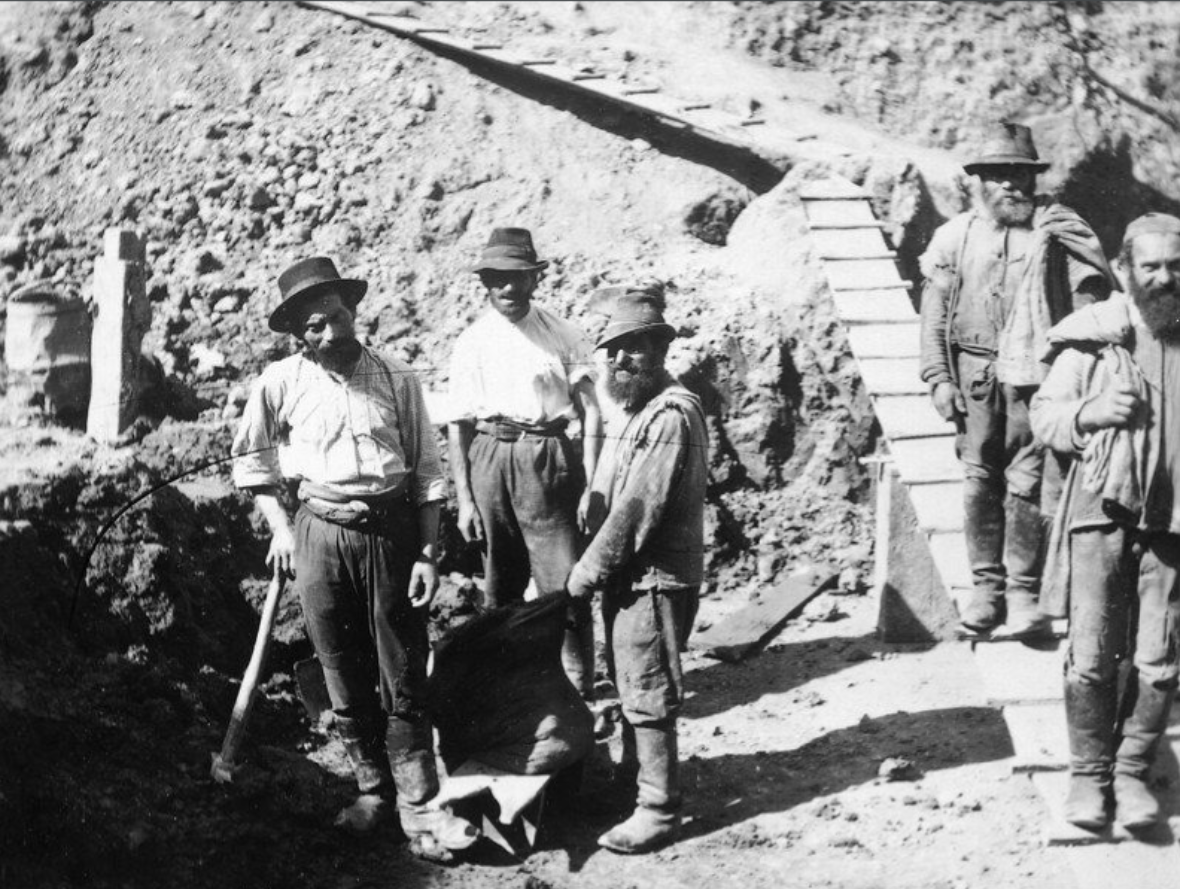
Between Galician Egypt and Palestine: The Unemployment Crisis and Jewish Ideas of Relief in the Boryslav Oil Basin


Dr. Vladyslava Moskalets
Center for Urban History15.7.2026, 18:30
Conference Room of the Center for Urban History
We invite you to a lecture by Vladyslava Moskalets, continuing the public lecture series "Let's Have a City ."
Despite its rapid success, the Boryslav oil dream coexisted with real problems, including a lack of infrastructure and safety in the mines. The professionalization of the oil industry and reforms linked to new safety requirements in the late 19th century led to mass unemployment among Jewish workers and middlemen. They mostly worked at small enterprises, and after these closed, they found themselves out on the street. In 1898, the streets of Boryslav were filled with crowds of unemployed people who could not support their families and were unable to find new jobs.
This crisis caused concern among Viennese political leaders, notably Theodor Herzl and Saul Raphael Landau, as well as international organizations such as the Baron Hirsch Foundation and the Jewish Colonization Association. Zionist leader Theodor Herzl addressed the plight of the Boryslav workers at the Second Zionist Congress in Basel. Philanthropists raised funds and sought to propose solutions to the problem—ranging from attempts to find employment for the workers within the empire to ideas for emigration to the United States.
An analysis of the information campaign in the Galician and Viennese Jewish press reveals how its leaders—primarily Viennese philanthropists and intellectuals—used the case of the Jewish workers from Boryslav to support socialist or Zionist theories regarding Eastern European Jews. At the same time, the campaign revealed a lack of understanding of the local Galician context and the inability of local elites to respond adequately. This led to the emergence of utopian and ineffective aid projects. The crisis of the Jewish workers in Boryslav, unfolding against a backdrop of widespread poverty, forced a reevaluation of the questions of belonging and the future of Galician Jews.
Historian, researcher at the Center. She received her PhD in history in 2017 in Krakow. Since 2016, she has been teaching courses related to Ukrainian and Jewish history of the 19th century, consumption history, and Hebrew. Senior lecturer at the Department of History of the Ukrainian Catholic University, coordinator of the Jewish Studies program. At the Center, Vladyslava is conducting a research project on the urban elites of Lviv in the second half of the 19th and the beginning of the 20th centuries. Moderator of the lecture. Historian, head of the Center’s educational projects. She is a candidate of Historical Studies, with a focus on gender and women’s history (2014, Ivan Krypiakevych Institute of Ukrainian Studies, National Academy of Sciences of Ukraine. Her research interests focus on women’s and social history in late 19th-century Habsburg Galicia. 
Dr. Vladyslava Moskalets
Center for Urban History 
Dr. Ivanna Cherchovych
Center for Urban History
Credits
Cover Image: Jewish workers, Boryslav, 1910 / Zygmunt Erdgaim / collection of Claudia Erdheim / Urban Media Archive of the Center for Urban History