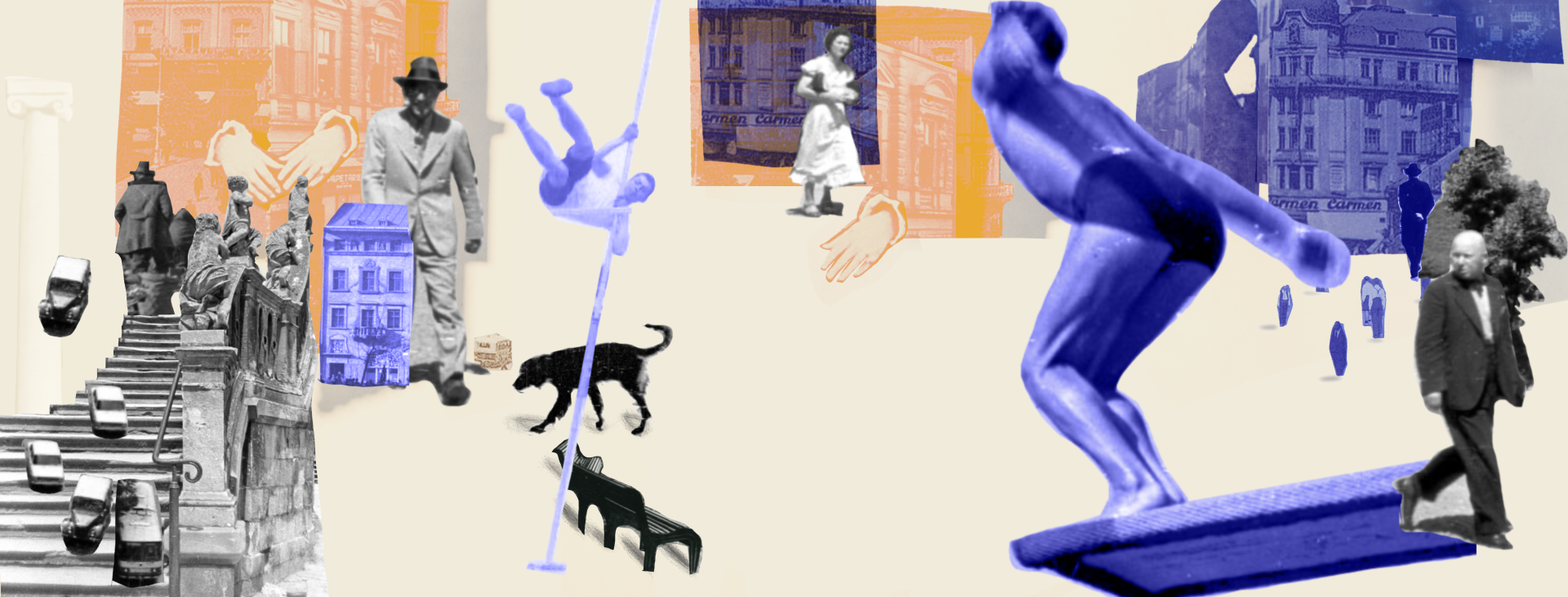
Let's Have a City...


May 2023 – December 2026
Conference Room of the Center for Urban History
A camera and a television tower, charities and protests, parks and exhibitions, machinery and vacations, plans for the future and disconnections with the past, a gained or lost home: these are just a sample of the narratives that can be found in studies of the history of modern cities.
The concepts of what a modern city should look like have been changing depending on political ideologies, economic and technological capabilities, as well as actions and visions of its inhabitants and thinkers. The expectations, and even the belief in progress and change for the better, which unfold linearly from the present to the future, are fundamental to modernity. That is why researchers draw our attention to those who outlined expectations and how they did so, and also to those who noticed disappointments and losses.
Modernity revealed itself through space and time, shaped them and the ideas about them. Adepts of modernity considered cities as laboratories of the future and their inhabitants as actors and visionaries. Critics, on the contrary, saw them as a concentration of problems and negative phenomena. Therefore, the modern city, both as a concept and as an experience, was determined by tensions between ideologues and actors — national, religious, social, professional, gender, and other communities or groups.
In 2023, the series of lectures "Let's Have a City" offers different views and approaches to the study of the modern city on the example of Lviv, a city with many public names (Lwów, Lemberg, לעמבערג) and private histories. In 2026, the program expands the geography of topics, welcoming conversations about the experiences of other cities.
During the program series, researchers will share the results of their research, showing changes in the social fabric and relationships, materiality and technology, symbolic meanings and ideological demonstrations, and everyday practices and decisions. We will raise questions: how do residents influence and shape the city? Who and what do they look up to in their actions? What ideas appeal to them, and what ideas do they adopt in Lviv? What communities are formed, changed, dissolved, and cease to exist in the city's space? How do technologies, trends, and economic impulses change urban spaces, citizens, and their everyday lives or behavioral practices? Although the topics of the lectures relate to the past, it is important for us to discuss them through the prism of the present and to find out what the legacies of ideas and experiences of the modern are in the current vision and experience of the city, as well as the future expectations.
THE TEAM
- Sofia Dyak, Viktoria Panas, curators of the series
- Maryana Mazurak, Yelyzaveta Bobrova, communication support
- Sofia Andrusyshyn, Oleksandr Dmytriyev, Anastasiia Moloko, logistical and technical support
- Bogdana Davydiuk, design
Credits
Cover Image: Bogdana Davydiuk