Social Media and Civic Digital Archiving for Researching Russia's War on Ukraine. Case Study of the Telegram Archive


Taras Nazaruk
2022 - now
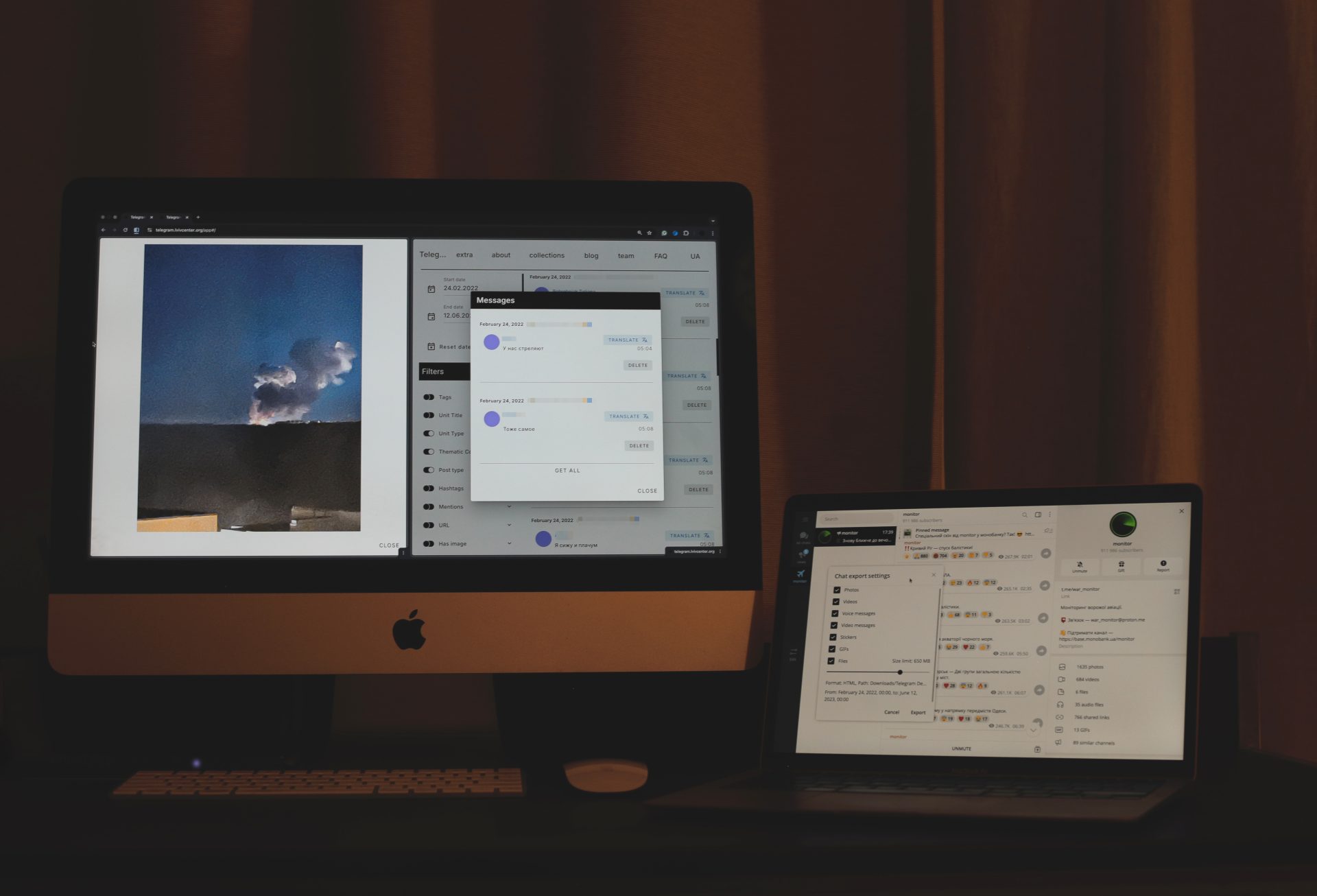
This project analyzes the practices of archiving Telegram, a widely used social media platform, in the context of the war in Ukraine. The empirical core of this research is the Telegram Archive of the War, an emergency archiving initiative launched by the author and a group of activists to preserve fragile and ephemeral war-related social media datasets. Examined through a theoretical framework of decentralized civic archiving as a critical data practice (Bareikytė & Skop, 2022), it provides informative insights into the affordances and challenges of creating an archival setting for social media data, a recently emerging field for academic study. The research focuses on the question of what political and sociotechnical conditions and implications civic community archives have as a critical data practice created in a platform society (van Es, 2017). Furthermore, what are the ethical and sustainable forms of knowledge production that utilize civic digital archives to critically engage with the extractivist mechanisms of data appropriation by economic and political powers?
One of the core aims of the project is to explore collaborative formats of archival access, aiming to minimize safety risks and the risks of unethical data use while simultaneously enhancing accessibility for researchers in the humanities and social sciences. In a situation where approaches to archiving social media and developing civic archives vary significantly depending on the platform or project, methodological toolsets for working with this particular platform and this particular historical context are needed, which in turn contributes to a broader discussion about rethinking the notion of archives and social media source interpretation as well as its connection with the field of digital public history.
The project is realized as a PhD project at the University of Hagen (supervisor – Prof. Dr. Felix Ackermann (FernUniversität in Hagen) / second supervisor – Prof. Dr. Miglė Bareikytė (European University Viadrina in Frankfurt/Oder) in сooperation with the Center for Urban History and with the support of the Hans Böckler Foundation. This research is a part of the larger project “Digitale Geschichten der Gewalt im 21. Jahrhundert. Partizipative Kriegsöffentlichkeiten und autobiographisches Erzählen in Russland, Belarus und der Ukraine” that focuses on digital histories of violence in the 21st century at the Department of Public History at FernUniversität Hagen and the research focus XXX at the Center for Urban History.
Publications
- 2025: Довжик, С. Назарук, Т. Отріщенко, Н. (ред.). Документування війни: між Україною і світом. Львів: Центр міської історії.
- 2025: Nazaruk T. "Do Androids Watch Electronic Films?" In: Klimenko, Natasha, Miglė Bareikytė, and Viktoriya Sereda (eds.), Images and Objects of Russia’s War against Ukraine, Forum Transregionale Studien – Dossiers, 05/2025, transcript Verlag, Bielefeld 2025
- 2025: Nazaruk T., Telegram – eine Dekade Meinungsfreiheit und Sorge um Sicherheit, Osteuropa 1-3/2025, S. 443–451.
- 2024: Ackermann F., Nazaruk T. Mythos Telegram, Geschichte der Gegenwart
- 2024: Avramenko O., Nazaruk T., Rubanska A., Serbulov D. Telegram Archive of the War. An initiative to preserve and organize data from the Telegram social network about the Russo-Ukrainian war. Two-year results of the project.
- 2024: Bareikytė, M., Makhortykh, M., Martin, A., Nazaruk, T., & Skop, Y. How should platforms be archived? On sustainable use practices of a Telegram Archive to study Russiaʼs war against Ukraine. Media, Culture & Society, 46(7), 1378-1396. [Link]
- 2024: Shumylovych B., Nazaruk T. “Lviv Interactive" and Exploring Artistsʼ Spaces on a Digital Map, Colloquia Humanistica, Digital Studies of Culture in Central Europe, No. 13. [Link]
- 2022: "Subscribe and Follow. Telegram and Responsive Archiving the War in Ukraine".Sociologica, 16(2), 217–226. [Link]
- 2022: Shumylovych B., Makhanets O., Nazaruk T., Otrishchenko N., Brunow D. "Preserving the now! Mediating Memories and Archiving Experiences in Ukraine" In: NECSUS_European Journal of Media Studies. #Materiality, Jg. 11. [Link]
- 2022: Nazaruk T. "A Few Thoughts on Silence, Space, and Memory," Hideouts. Architecture of Survival Catalogue, ed. Wenzel M., Szreder K., Romik N., Janus A., Janitschek K., Hatje Cantz Verlag
- Marino I., Nazaruk T. "Archives and the Practice of History in Times of Collective Catastrophes: A comparative study of the projects Coronarchive and the Most Documented War", 'Digital History and Hermeneutics' series, Luxembourg Centre for Contemporary and Digital History (C²DH) (manuscript)
- "Digital Tools and Old Heuristic Methods: Placing Artists on the Map", Colloquia Humanistica, Digital Studies of Culture in Central Europe, by Shumylovych B., Nazaruk T. (manuscript)
Events
- 2023-2026: The Most Documented War. Symposium for Documentation and Archiving Initiatives
- 2022: Russia's War in Ukraine: Interdisciplinary Data Sprint with Telegram Archives
- 2022: Digital Archiving: Challenges and Opportunities of Archiving Social Media Data in the Context of Crisis Events
- 2022: EHRI Seminar "Documenting the War. Past and Present"