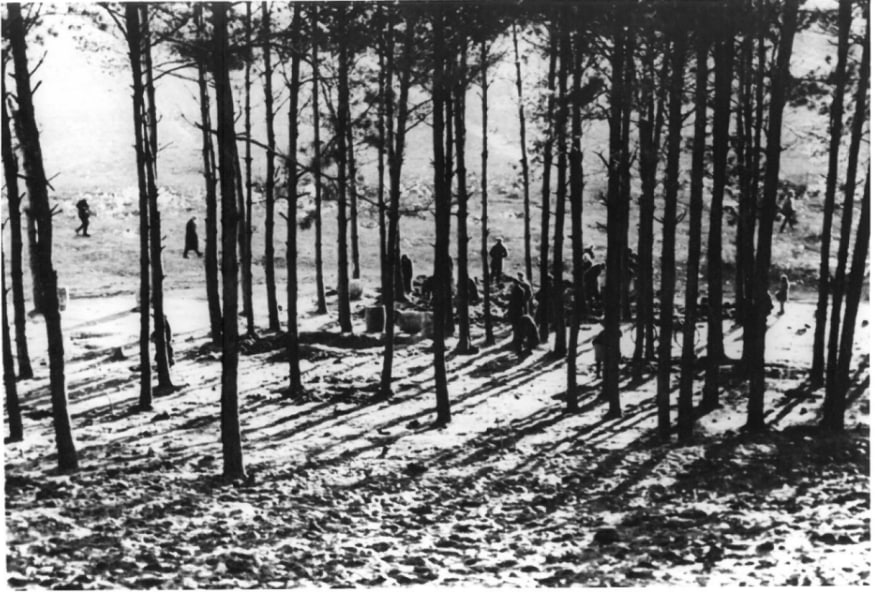
Sosonky: Crime, Amnesia, Memory


Maksym Gon
Rivne State Humanitarian University15.11.2026, 14:00
Art Base of the Rivne House of Chamber and Organ Music
We invite you to a lecture by Maksym Gon in commemoration of the Day of Remembrance for the Victims of Sosonky.
German troops entered Rivne on June 27–28, 1941, and immediately, the streets of the city witnessed the beginning of the persecution of the Jewish population and the first sporadic killings carried out by Wehrmacht soldiers. Subsequently, Sonderkommando 4A entered the city and, together with the auxiliary police (at that time, the Ukrainian militia), carried out the first organized mass killing of approximately 130 Jewish men on July 8–9, 1941. A similar operation was repeated on July 12, 1941. In total, during the summer of 1941, various units of the Nazi occupation administration may have shot anywhere from several hundred to 1,000 Jews.
As of mid-August 1941, 19,963 members of the Jewish community continued to live in Rivne, while another 474 resided in villages in the Rivne district. They were ordered to establish a Judenrat, were subjected to a series of restrictions on movement, and were burdened with exorbitant taxes. The culmination of Nazi violence against the Jews of Rivne was the mass killings in Sosonky, which took place on November 6–7, 1941. During those days, according to various estimates, between 15,000 and 17,500 Jews from the city were shot.
Between November 1941 and February 1942, the Rivne Ghetto was established, imprisoning approximately 5,000 Jews from Rivne and the surrounding villages who had survived the shootings. On July 13, 1942, the German occupation authorities liquidated the ghetto: the prisoners were taken to a forest near Kostopol and shot. Some managed to escape, but only a few survived until February 1944, when Soviet troops entered Rivne.
During the lecture, we will discuss not only the Nazi crimes in Rivne but also the contemporary dilemma of preserving the memory of the victims of Nazism who rest in the Sosonky tract. We will examine the Jewish community's initiatives to establish a separate memorial site; the specific policies of local authorities from the 1950s to the late 1980s; and the creation of a memorial at the site of the mass graves in the 1990s. We will also attempt to analyze the issue of how Sosonky has been addressed in recent decades.
Maksym Gon
Rivne State Humanitarian UniversityDoctor of Political Science, Professor; he obtained his higher education at the Faculty of History of the Ivano-Frankivsk State University of Humanities. He taught at schools in Rivne. He served as Head of the Department of Political Science at Rivne State Humanitarian University (RSHU). He took part in combat operations (March 2022–July 2026) during the War for Ukraine’s Independence. Since his demobilization, he has been working as a professor in the Department of History at RSHU.

Petro Dolhanov
Moderator of the event. PhD in History, Associate Professor of the Department of Teaching Methods at the Rivne Regional Institute of Postgraduate Pedagogical Education, a member of the Mykola Haievoi Center for Contemporary History, editor of the section “Overcoming the Past” and guest editor of a special thematic issue on the Holocaust in the journal “Ukraina Moderna”. He is the author of the monograph ‘Each to Their Own’: The Socioeconomic Dimension of Ukrainian Nation-building in Interwar Poland (Rivne, 2018). He is the author of a series of publications on the history of the Holocaust in the cities and towns of western Volyn, The Life and Death of Jewish Communities.
The lecture will take place as part of the public program "Weaving the Heritage" of the "REHERIT 2.0: Common Responsibility for Shared Heritage" project.
The "REHERIT 2.0" project is implemented by the Center for Urban History and the "Regional Development" Center of the PPV Economic Development Agency with financial support from the European Union.
This publication was created with the financial support of the European Union. The content is the sole responsibility of the partners of the “REHERIT 2.0” project and does not necessarily reflect the views of the European Union.


Credits
Cover Image: Mass graves unearthed in Sosonky / photograph from the Bundesarchiv