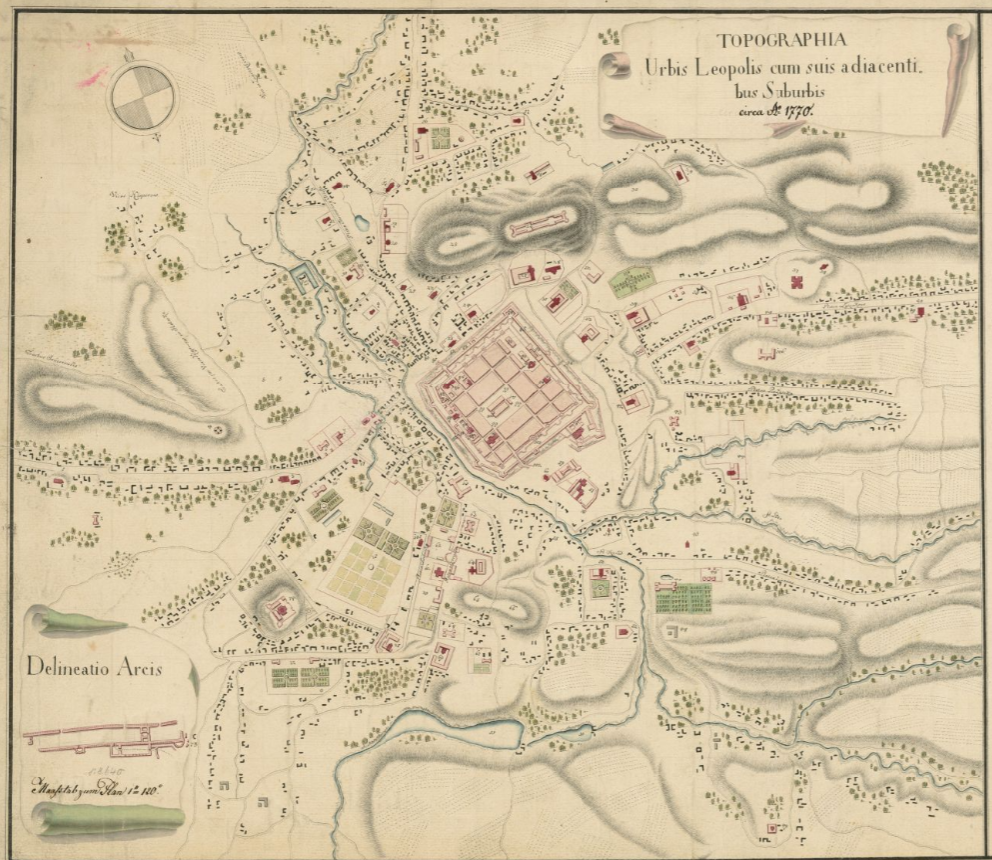
Urban Space as a Historical Category: The Case of Lviv at the Turn of the 18th and 19th Centuries


Dr. Aleksander Łupienko
T. Manteuffel Institute of History, Polish Academy of Sciences, Warsaw28.9.2026, 15:00
Ukrainian Cartholic University, r.404, 2A Kozelnytska Str.
For the past ten years, Dr. Aleksander Łupienko has been researching the urban space of Lviv during the "long" 19th century (1772–1914), seeking to steer the methodology of urban history in a new direction. His goal is to present space as a significant historical factor: a force that shaped human decisions and ideas and, to a certain extent, influenced the course of history. This shift in perspective is intended to highlight specific physical, spatial, and local historical factors.
During the seminar, the historian will focus on the early phase of the period under study—from 1772 to the early 19th century—when a neglected city of the Polish-Lithuanian Commonwealth came under Habsburg rule. The discussion will address the spatial environment that shaped the city's history, as well as the interaction between the Enlightenment worldview of the new ruling elite and the landscape of the Crown Lands and its newly established capital. In particular, we will discuss the influence of space, the ideals of both the new and old elites, as well as the compromises they were forced to make.
Aleksander Łupienko's presentation is based on one of the first chapters of his forthcoming book dedicated to the spatial history of Lviv during the "long" 19th century.
The history seminar is organized by the Department of History at UCU in partnership with the Center for Urban History.
[sg_persons]
[sg_logo]
Images
Cover Image: Topography of the city of Leopolis with surrounding suburbs, map from the 1770s / Collection of the Austrian Military Archives / Urban Media Archive of the Center for Urban History