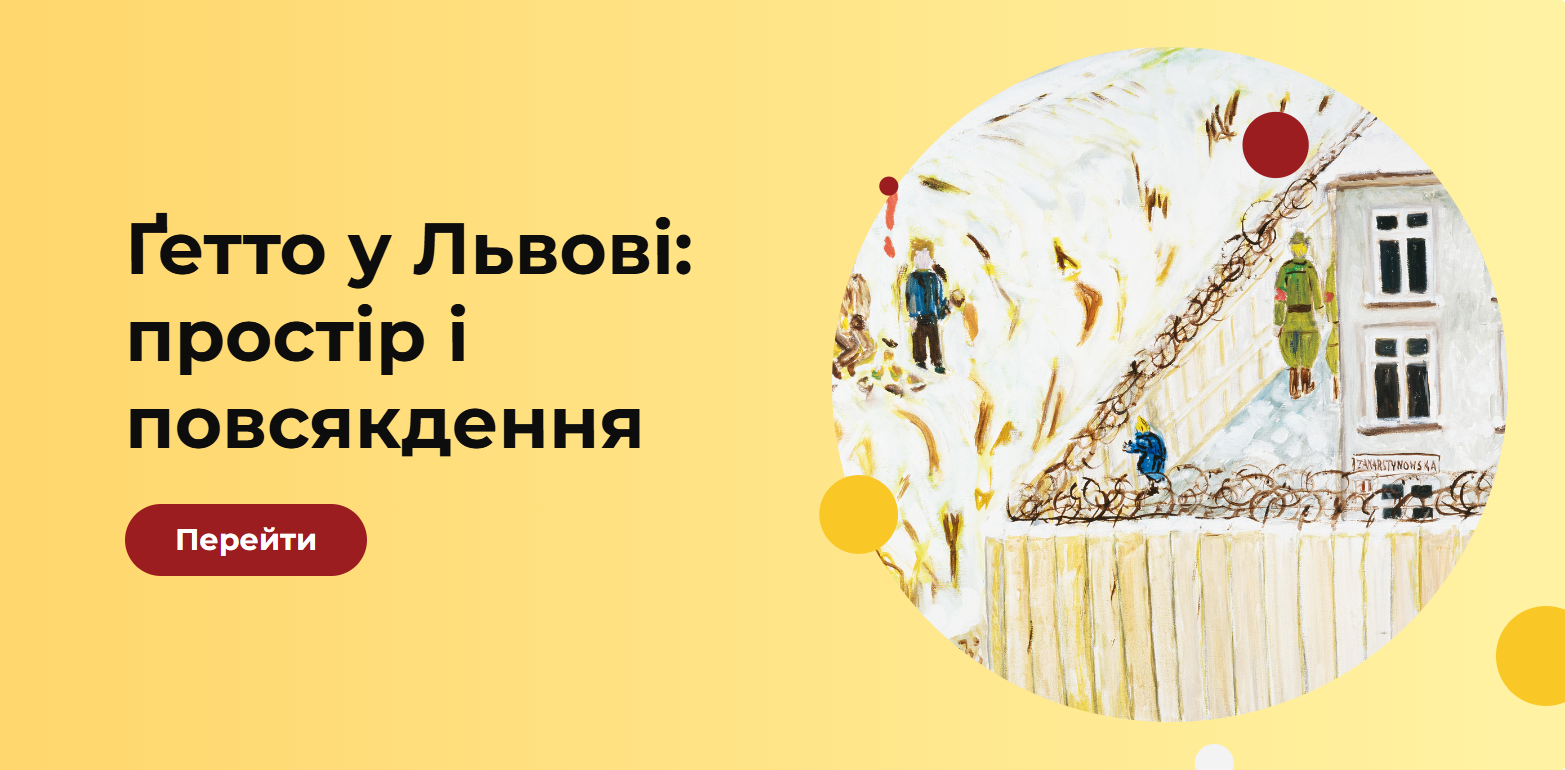
Ghetto in Lviv: Space and Everyday Life


31.10.2025
A new publication, Ghetto in Lviv: Space and Everyday Life, is available for reading on the online platform Lviv Interactive, which was made possible through the collaboration of the Center for Urban History and students of the Ukrainian Catholic University.
The idea for the publication crystallized when historian and Center researcher Vladyslava Moskalets was preparing a course on the "Economic History of the Holocaust" for students of the Ukrainian Catholic University as part of the socially oriented education program.
The team of the Interactive Lviv platform has already had experience in implementing student projects that arise within the framework of our colleagues' educational courses: for example, the project "LIVE (through) the 1990s" in cooperation with the UCU Department of Cultural Studies, or as part of Martin Rohde's course for masters. This time, we decided to invite students to work with materials previously published on Interactive Lviv on the topic of the Holocaust. First of all, it was the research of the Reherit project (2018-2021), namely, "The Complicated Pages of Common History: Telling About World War II in Lviv"; urban digital walks that were created based on the materials of summer schools and public programs at the Center for Urban History. The processing of these materials and experimentation during the educational process allowed us to structure and create a new digital publication.
It was important for us to highlight the boundaries of urban space and its closeness/openness. Therefore, part of the Lviv Interactive team's work with students was to structure metadata and map it using digital tools. Based on the sources they processed, they managed to create several layers with relevant data. As a result, a map of everyday life in the ghetto in Lviv was created, showing places related to its borders, main institutions, places of hiding, and trade.
The map is accompanied by texts, mostly based on memoirs and interviews. They are based on the question of how a city can change when part of its population is isolated. How total was this isolation-or was the ghetto rather porous, and was the genocide not separated from the everyday life of the rest of the city? The trams that ran past the ghetto wall or even drove into it, the columns of workers who went out to work every day, the children who tried to get food at the market outside the fence, show how closely the lives of the ghetto residents were connected to the rest of the city. The map itself and its accompanying texts create a spatially rooted narrative of everyday life in the ghetto that will also allow contemporary residents to look at the streets and houses nearby with new eyes.
All publications on Lviv Interactive are subject to scientific and literary editing, as well as translation, and the project Ghettoes in Lviv: Space and Everyday Life is no exception. We express our gratitude to all of our colleagues whose research formed the basis of this publication, as well as to all those who created and accompanied it to completion.
The work on the publication was coordinated by Roksolyana Holovata and Vladyslava Moskalets.
Authors of the map layers and research texts:
- Vladyslava Moskalets (Introduction),
- Anastasia Mongold (Ghetto Boundaries),
- Andre Kolesha (Ghetto Self-Governance),
- Diana Yarmus (Transport and Movement),
- Yulia Pisklynets (Places of Forced Labor),
- Viktoriia Logvynchuk (Places of Trade),
- Kamila Chernetsova (Social Infrastructure),
- Liliana Moskaliuk (Places of Hiding).
Text editors: Roksolyana Holovata, Vladyslava Moskalets, Vira Trach.
Editing map layers and creating a digital publication: Roksolyana Holovata, Vladyslav Muravsky.
Literary editor: Roman Melnyk.
Translator of the text into English: Yulia Kulish.
Advisors: Sofia Dyak, Taras Nazaruk, Andriy Usach.