The Materiality of a Border in the Move. Soviet Violent Bordering in the 1940s and The Search for an Unattainable Territorialized Loyalty


Sabine Dullin
Sciences Po Paris17.9.2026, 18:30
Conference Room of the Center for Urban History
We invite you to a public lecture by Sabine Dullin, held as part of the conference "Experiencing the Borders: The Long 1940s and Their Legacies in (Eastern) Europe."
Two major changes occurred in the western borders of the Soviet Union, specifically those of the Soviet Republic of Ukraine: first, after the annexations following the Soviet-German pact; second, after the victorious advance of the Soviet army at the end of the war. The lecture will discuss how this change shaped the everyday life of the inhabitants for whom a border was a new local reality.
The border, which was the Soviet western border in the 1940s, remains territorially active and tightly controlled, as it is the current border of the European Union and, since 2022, has been under threat. Ukraine and Moldova on one side, Poland, Slovakia, Hungary, and Romania on the other. For historians, this border is a living archive in the open air. The very experience of walking along and crossing it, interviewing people, gives access to the materiality of the border built in the 1940s.
For studying border work—a term used by Madeleine Reeves, an anthropologist working on current borders in Central Asia—in the 1940s, this lecture will attempt to understand the border not only as an imposition from above of a new line on the map but also as a social construct with many players. Sabine Dullin will show the timeframe: first, the uncertainty of war and its aftermath, when territorial affiliation is still fluctuating, as well as the violent closing of the border as a thick and forbidden space. The conversation will focus on the border around Uzhgorod and Chop, where bordering and managing nationalities by the Soviets searching for local loyalty led to an experience of the border different from Galicia.
Sabine Dullin
Sciences Po ParisProfessor of contemporary history at Sciences Po Paris and researcher at the Centre d’histoire. She is specialist on the history of Russian Empire and the Soviet Union, history of communism and the Cold War. She is interested in the history of borders, borderlands, and sovereignty in Eastern Europe and in Siberia, issues of colonization and decolonization in a political, social and environmental perspective. She did field works in Ukraine, in the archive at Kyiv and Uzhgorod, conducted interviews in Transcarpatia at the border with Hungary and Slovakia.
Iryna Sklokina
Center for Urban HistoryModerator of the event. Historian, researcher at the Center. She defended her PhD (2014) on the official Soviet policy of memory of the Nazi occupation of Ukraine (Kharkiv region). She took part in the SOCIOBORD project (Social Politics in European Borderlands. A Comparative and Transnational Study, 1870s-1990s).
"Experiencing the Borders: The Long 1940s and Their Legacies in (Eastern) Europe" conference is part of the activities of the "War and Society in Central and Eastern Europe (20th-21st centuries)" Research Alliance (EURETES, EHESS-MESR), which brings together the Center for Russian, Caucasian, East-European and Central-Asian Studies at the School for Advanced Studies in Social Sciences (CERCEC-EHESS) in Paris, Institute of International Studies, Faculty of Social Sciences at Charles University in Prague, and the Center of Urban History.
Co-organizers of the conference:
- Center of Urban History, Lviv
- Center for Russian, Caucasian, East-European and Central-Asian Studies, School for Advanced Studies in Social Sciences (CERCEC-EHESS), Paris
- Institute of International Studies, Faculty of Social Sciences, Charles University, Prague
- Research Centre Ukraine / Max Weber Foundation, Lviv
Partners:
- Documenting Ukraine / Institute of Human Sciences, Vienna
- The Institute of Ethnology, Czech Academy of Sciences, Prague (ERC-Project MEMPOP)






Credits
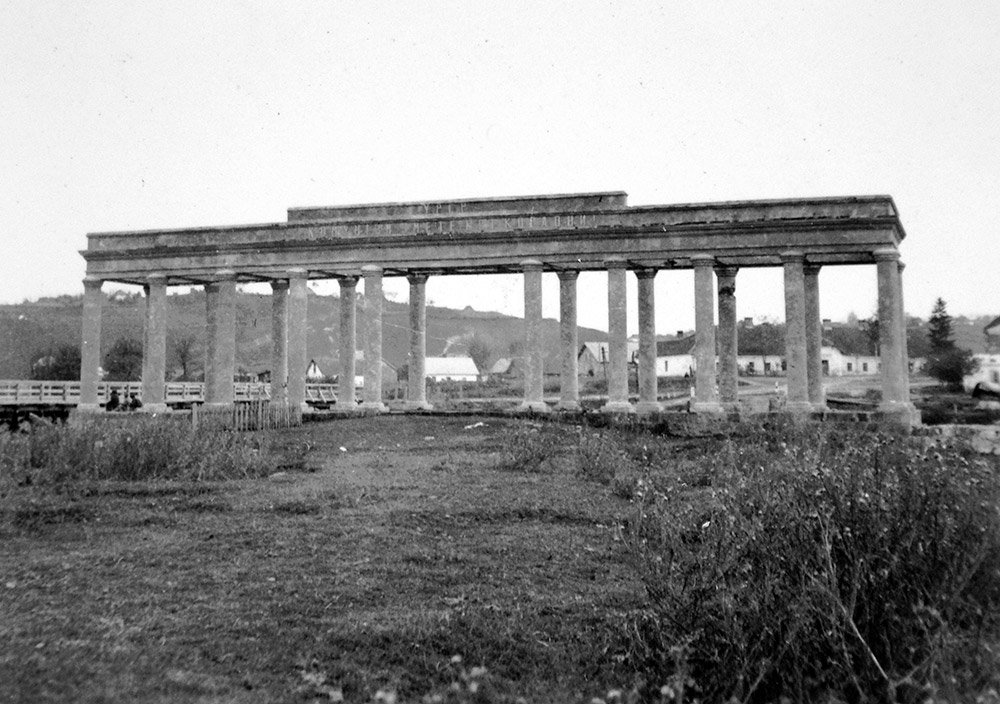
Cover Image: A border colonnade in the Ternopil region in 1942
Gallery: Mariia Urban