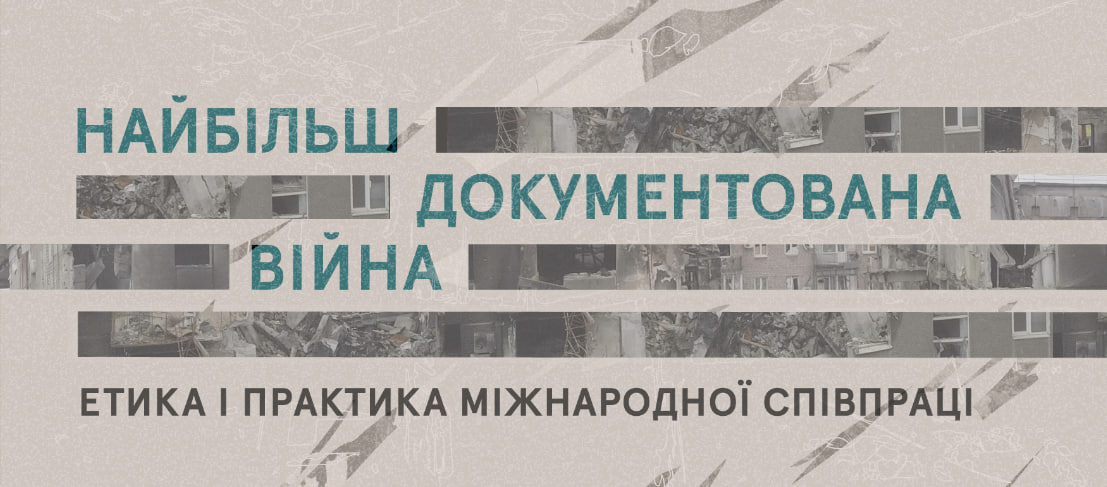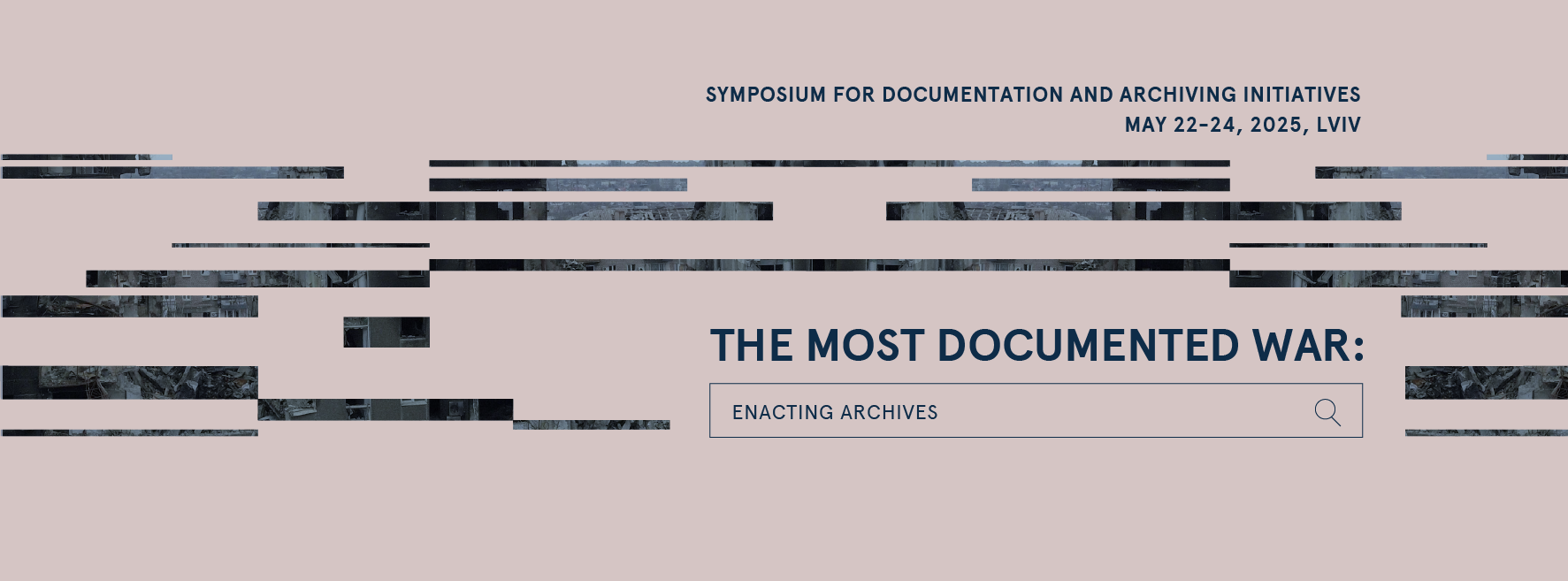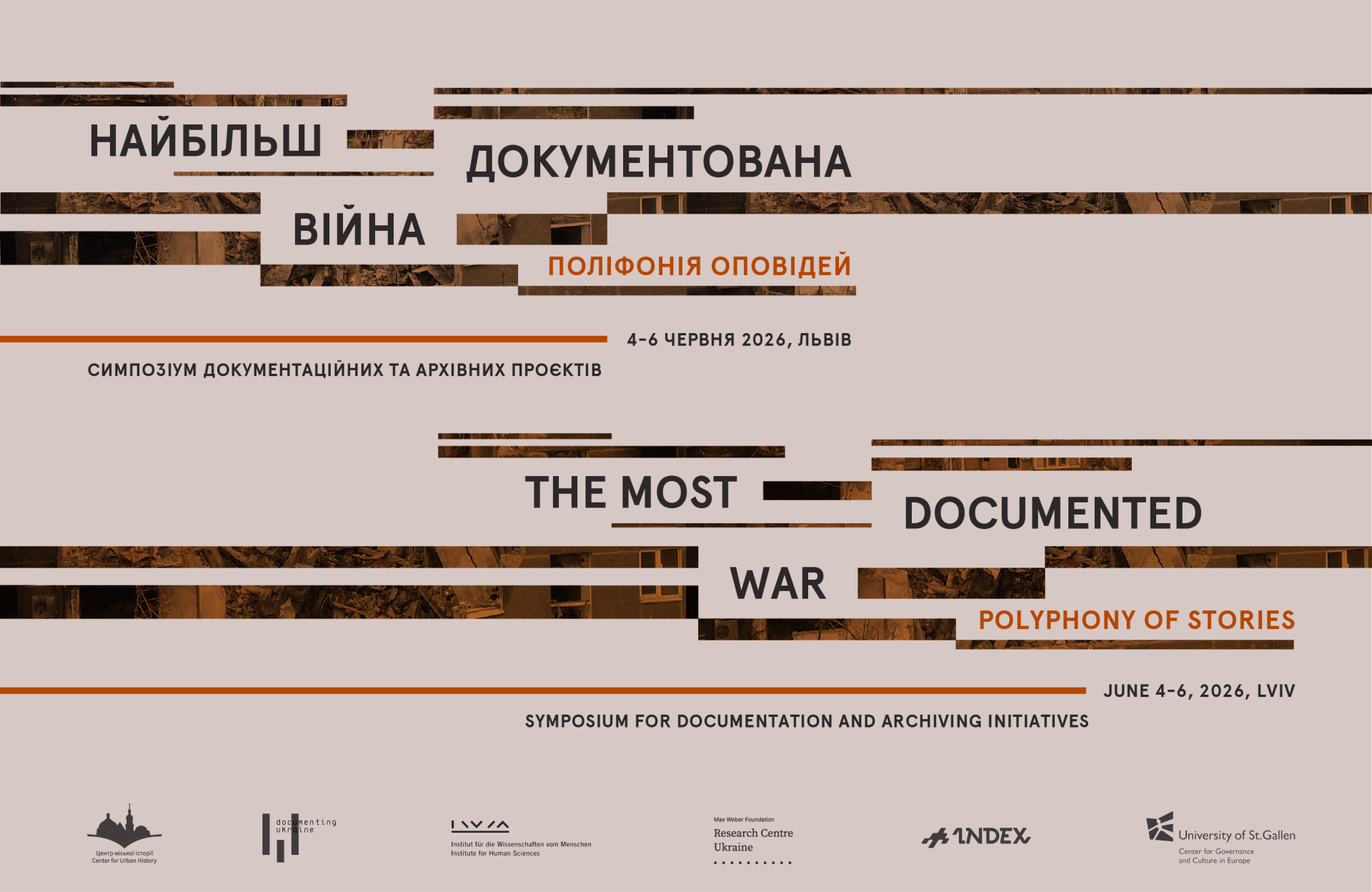
The Most Documented War: Polyphony of Stories


4-6.6.2026
Lviv
What we know of the siege of Troy comes from Homer's account. The story of the Trojan War has been handed to us in the shape of an epic poem. We know much about Achilles' fight and Odysseus's cunning, but we only have a scant sense of what life in the city was like over those ten years. This is how stories provide frameworks that shape our understanding of what war is and how it can end. Over nearly four years of full-scale Russian aggression against Ukraine, many stories have emerged to explain it: stories of resilience and ingenuity, vulnerability and suffering, triumph and shame, hopelessness and agency, subjugation and freedom, death and life.
In war, people tell stories for many reasons. Some use them to rescue themselves, others to rescue those around them. Well-developed or rudimentary plots and thoughts are shaped into arguments, and they complement narratives that seem to float around on their own, without a clearly defined source. We construct such narratives daily, whether we voice them or keep them to ourselves. Through them, we imagine ourselves and the world around us.
Words take on special weight in every war. To tell stories in wartime means to survive, to hear and to feel, to confer meaning to events, facts, and things. Responsibility for what we have witnessed compels us to voice, to articulate, to refute.
A call from the front, a story recounted by a neighbor, a book, a published diary, a witness testimony, an artwork in a gallery, footage shot on an action camera, an analytical report, a presentation, a 3D model, a bibliographic description, or an archival record – taken together, all these contribute to the narrative frameworks of ‘the most documented war.’ War finds its place and is imagined in collective or individual experience through these frames, thereby influencing everyday decisions or political ones. Stories in war are not merely reflections of reality. They become a means to define truth, give meaning to experiences, emotions, and interactions, and serve as instruments to explain decisions.
We invite you to participate in the fourth annual Symposium of Documentation and Archival Initiatives, where we think about polyphony: who speaks and what is voiced in these stories, whose voices are heard and whose remain marginalized, how stories change under the influence of political conditions and media, how they merge or contradict one another. We invite you to join us in discussing the symphony of different voices, of dissonance and cacophony, the tone and timbre of narratives, but also the unspoken, the unvoiced, the silenced. We propose to look at various geographies and chronologies of wars and conflicts, each of which produces different narratives that merge, complement, or undermine one another. By studying other post-war experiences, we hope to gain more awareness to navigate the challenges that Ukrainian society will face.
This year, we plan to think together about the following topics:
- Sources: How do the sources we gather or create shape narratives? Which sources are unnoticed, lost, or not even created? What role do infrastructures play in this, e.g. where sources are stored, processed, and presented?
- Emotions and tonality: How does the chosen tone of a story impact on its perception by different audiences?
- Narrative as a space for justice: How do the documents we collect help us create stories that go beyond feelings of injustice and the difficulties in understanding? When does the sense of inner duty to testify find its place in everyday life? Who speaks on behalf of those who cannot do so themselves?
- Instruments of storytelling: To what extent do audiences, genres, and styles influence the way a story is constructed? Given the exhaustion of meanings, how can we find adequate language? What are the advantages and risks of linguistic synchronization and uniformization?
- Multiplicity of dichotomies: How can storytelling unite or divide us? What might help us move beyond dichotomous thinking? How can stories be created to include the experiences of many without fragmenting or polarizing those who lived through them?
- The unspoken in the narrative space: How can polyphony be preserved when topics and issues monopolize the information field? What remains unspoken, (self-)censored, postponed? How does the euphemism ‘not the right time’ deepen the silence and contribute to our inability to speak?
- Trajectories of wars and post-war periods: How does knowledge of past wars and conflicts and others' experiences influence our perceptions of possible scenarios? To what extent do familiar temporalities and geographies form templates for new narratives?
This year's Symposium program will consist of various formats: panel discussions, Q&A sessions, networking, films, trainings, and informal opportunities to exchange experiences.
Working language: Ukrainian and English.
Registration—by the link. Deadline: 26 January 2026. Selection results will be announced by February 13. The number of places is limited. A number of stipends for travel and accommodation costs will be made available for participants travelling to Lviv.
ORGANIZERS:
- Center for Urban History, Lviv
- Documenting Ukraine / Institute for Human Sciences, Vienna
- Research Centre Ukraine / Max Weber Foundation, Lviv / Bonn
- INDEX: Institute for Documentation and Exchange, Lviv
PARTNERS:
- Center for Governance and Culture in Europe / University of St.Gallen
- LivArch / Herder Institute, Marburg
- CERCEC / EHESS, Paris
Program Committee of the Symposium 2026:
- Liana Blikharska, Center for Urban History
- Taras Nazaruk, Center for Urban History
- Natalia Otrishchenko, Center for Urban History
- Diána Vonnák, Institute of Ethnology / Czech Academy of Sciences
- Olesya Yaremchuk, INDEX: Institute for Documentation and Exchange
Program Board of the Symposium 2026:
- Sofia Dyak, Center for Urban History
- Katherine Younger, University of Glasgow, Documenting Ukraine / Institute for
Human Sciences - Iryna Klymenko, Research Centre Ukraine / Max Weber Foundation
- Sasha Dovzhyk, INDEX: Institute for Documentation and Exchange
Organizational Committee:
- Sofia Andrusyshyn, Nataliya Machalina, Anastasiia Kovach, Maryna Melnychenko, Yulia Kohut, coordination and logistics
- Yelyzaveta Bobrova, Tetiana Bots, communications
- Viktoria Panas, Maryana Mazurak, facilitation
- Yaryna Paniv, Ivanna Pekh, finance
- Oksana Demkiv, design


Credits
Cover Image: Oksana Demkiv