Experiencing the Borders: The Long 1940s and Their Legacies in (Eastern) Europe


16.9.2026
Center for Urban History / hybrid
Wars intensify borders in multiple ways: along with administrative hardening, securitization, and militarization, wartime also enhances the importance of migration and refuge, the transfer of supplies and technologies, as well as processes of social re/bordering within societies, including the radical reconfiguration of gender orders. Wars are also about shifting, fading, and disappearing borders. Looking at borders in the context of mass violence, especially wars, benefits from recent interdisciplinary scholarship that treats them not as fixed spatial delimitations of territory, drawn and redrawn throughout history by states and governments, but as an everyday social reality constituted through contingent bordering processes. These processes involve a multitude of social actors, practices, narratives, and materialities. By foregrounding the lived experience of borders, we intend to place at the center the agency of those who engage with them—whether regularly or occasionally—and who, through embodied experience, participate in their everyday (re)creation. In this sense, borders are continuously enacted, appropriated, and contested through mundane encounters that both reproduce and potentially destabilize their meaning and effects.
The conference will focus on the multiple borders in Europe that were drawn and redrawn, experienced and installed, moved and secured throughout the long 1940s—a period of violence and upheaval shaped by annexation, war, occupation, and postwar settlements. Thus, the opening moment of this period can be located in the Anschluss of 1938, followed by a cascade of annexations that turned borders into military frontiers after 1939; the establishment of different occupation zones; postwar border settlements formalized through agreements signed, and people moved. The last pieces of this new re/bordering puzzle were put in place by the mid-1950s.
The border system that emerged from the long 1940s defined the continent for several decades through closure, constrained mobility, and apparent stability, known as the Cold War period. This system transformed with the collapse of two composite socialist states: the Soviet Union and Yugoslavia. Borders in Europe became more open for many people. At the same time, they were reconceptualized, contested, and redrawn again. One major story of this period was the expansion of the free movement area within Schengen, which also meant the securitization of the European Union's newly defined external borders. Another story we would like to focus on concerns borders and war since 1991. From the Yugoslav Wars, which marked the return of warfare to the European continent, through the annexation of Crimea by the Russian Federation in 2014, to the full-scale invasion of Ukraine in 2022, the entire border system that originated in the long 1940s is being challenged and changed.
The long 1940s were a critical juncture in the processes of defining and seeing minorities as a "problem" to be solved by physical destruction (ethnic cleansing, genocide) or forced population displacement. These violent policies were driven by visions of homogenized societies and controlling states—logics that were exactly the opposite of that of the post-WWI period, when mechanisms of minority protection were developed in international law and implemented, with varying success, at the state and regional levels. As a result, the long 1940s became the decade of the radical disappearance of minorities in Europe, especially in its Eastern and Central parts, leading to a dramatic decline in coexistence among people of diverse faiths, languages, and cultures, as noted by István Deák. This loss of diversity can be defined as the most important change not only in the social, cultural, political, and economic life of the region, but also in the life of specific places—from large cities to small towns and villages—as well as neighborhoods, families, and even personal lives.
Since 1991, this internationally established border system has been radically transforming, and increasingly violently so. It is no coincidence that this new era has witnessed the spectacular development of border studies in the social sciences. The changes included both unprecedented openness for and solidarity with refugees as well as closure and securitization in response to aggression; new waves and directions of migration, new hierarchies of the "(un)welcomed", the rupture of air connection and the growing importance of land and landscape for illegal border crossing—both as individual survival strategy and as a part of hybrid warfare; new routes and new technologies, most recently and importantly drones. In other words, borders can be seen as key sites for exploring and experiencing the period, which became more turbulent and violent.
Taking these two periods—the historical and the more contemporary—as points of reference, we would like to look not only at state borders but at complex and composite border systems of different types and kinds. These include state borders recognized under international law and transgressed in the acts of annexation or declarations of war; borders between and within occupation zones (such as ghetto borders); borders delineating zones of control and borders dividing ideological systems (such as the "Iron Curtain", which was both closed and permeable); state borders within ideological blocs, in particular within the Socialist Bloc; borders within supranational entities. Furthermore, borders were more than lines delineating territories; they were both tools and markers of a radical and major societal change.
We welcome researchers who engage with these periods across different European geographies—particularly Eastern, Central, and Southeastern Europe, but not exclusively—and offer a perspective on borders as social constructs. Contributions may focus on borders "from above", examining shifting spatial delimitations shaped by states and their effects on persons (border regimes, welfare policies), and on borders "from below", exploring lived experiences and entanglements between borders and people's agency that socially (re)construct the borders.
We invite submissions focusing on the following topics:
- Borders experienced and imagined: expectations and decision-making; borders and experiences of minorities; violence, war, crisis, solidarity, and security in the borderlands; the circulation of people and things, and multiple migrations;
- Materiality of borders and environment: materialities and resources used in border construction and maintenance; natural objects as border signs, landscape and bordering practice; border staging;
- Multiple types of borders and modes of bordering: borders and war frontlines/demarcation lines, occupation zones; the border between the USSR and the Socialist bloc and its legacies; hard/mild borders; hierarchies/sets of borders and their permeability; global trajectories of displacement caused by border changes;
- Movement and bodily experiences: crossings by humans and non-humans; bodily experiences of border crossing; means and modes of transportation; degrees of permeability; legal and illegal border crossing;
- Social relations: reconstruction of social fabric and filling social voids; mobility and connectivity across the borders: translocal families, lost children; loyalty, citizenship, and belonging in the borderlands; gendered experiences of borders;
- Welfare: welfare regimes on the borderlands: migration/relocation and hierarchies of welfare provision, discrimination and affirmative actions;
- Temporalities: long histories of migration; mobility after displacement and histories of return (and repatriation); fading, former, formal/informal borders; alternations between closure during the Cold War, opening after the collapse of the Eastern European regimes and the USSR, and gradual re-closure since the mid-2010s (Russo-Ukrainian war, refugee crisis, health crisis, migrant crisis on the EU-Belarus border);
- Urban/rural perspectives: spaces of re/integration, cities and rural areas as migrants' destinations, regulations and restrictions of migrants'/repatriates' settlement in cities; split and entangled settlements;
- Property issues: property as advantage and threat in times of radical change; redistribution of property due to re-bordering processes; property and citizenship; material relocation and exchange; movable property (including animals) and related regulations;
- History and methodology of border studies applied to wartime contexts.
We welcome submissions (max. 700 words) from scholars in the humanities and social sciences. Submissions from early-career researchers are explicitly encouraged. Applications should be sent to conferences@lvivcenter.org by April 20, 2026, with the subject line "Experiencing the Borders." Notifications of acceptance will be sent by May 5, 2026. We expect to have draft papers or notes submitted to discussants by September 7, 2026.
The conference language will be English. Organizers can provide assistance to the conference participants with limited English proficiency but strong proposals.
The conference will take place on 16-18 September 2026 in Lviv (Ukraine). Online participation will be possible; however, preference will be given to in-person attendance. The organizers will cover travel and accommodation costs for all participants who are not funded by their home institutions.
This conference is part of the activities of the "War and Society in Central and Eastern Europe (20th-21st centuries)" Research Alliance (EURETES, EHESS-MESR), which brings together the Center for Russian, Caucasian, East-European and Central-Asian Studies at the School for Advanced Studies in Social Sciences (CERCEC-EHESS) in Paris, Institute of International Studies, Faculty of Social Sciences at Charles University in Prague, and the Center of Urban History. The conference will be hosted in Lviv by the Center for Urban History in cooperation with the Research Centre Ukraine / Max Weber Foundation.
Program Committee:
- Sofia Dyak, Center of Urban History
- Catherine Gousseff, CERCEC-EHESS
- Ioulia Shukan, CERCEC-EHESS
- Iryna Sklokina, Center of Urban History
Academic Committee:
- Sabine Dullin, Sciences Po, Paris
- Franziska Exeler, The Free University of Berlin
- Michal Frankl, Leibniz Institute for the History and Culture of Eastern Europe (GWZO), Prague
- Katharina Friedla, European Collections at the Hoover Institution, Stanford University, Palo Alto
- Béatrice von Hirschhausen, CNRS, Géographie-cités & Centre Marc Bloch, Berlin
- Iryna Klymenko, Research Centre Ukraine / Max Weber Foundation, Lviv
- Ota Konrad, Institute of International Studies, Faculty of Social Sciences, Charles University, Prague
- Oksana Mikheieva, Kyiv School of Economics
- Tetiana Pastushenko, CERCEC-EHESS, Paris/Institute of History, Academy of Sciences of Ukraine, Kyiv
- Olga Sasunkevich, University of Gothenburg
- Philippe Ther, The University of Vienna
- Anna Wylegala, Institute of Philosophy and Sociology, Polish Academy of Sciences, Warsaw
- Katherine Younger, The University of Glasgow
- Tatiana Zhurzhenko, ZOiS-Centre for East European and International Studies, Berlin
- Ondřej Žíla, Institute of International Studies, Faculty of Social Sciences, Charles University, Prague
Co-organizers:
- Center of Urban History, Lviv
- Center for Russian, Caucasian, East-European and Central-Asian Studies, School for Advanced Studies in Social Sciences (CERCEC-EHESS), Paris
- Institute of International Studies, Faculty of Social Sciences, Charles University, Prague
- Research Centre Ukraine / Max Weber Foundation, Lviv




Credits
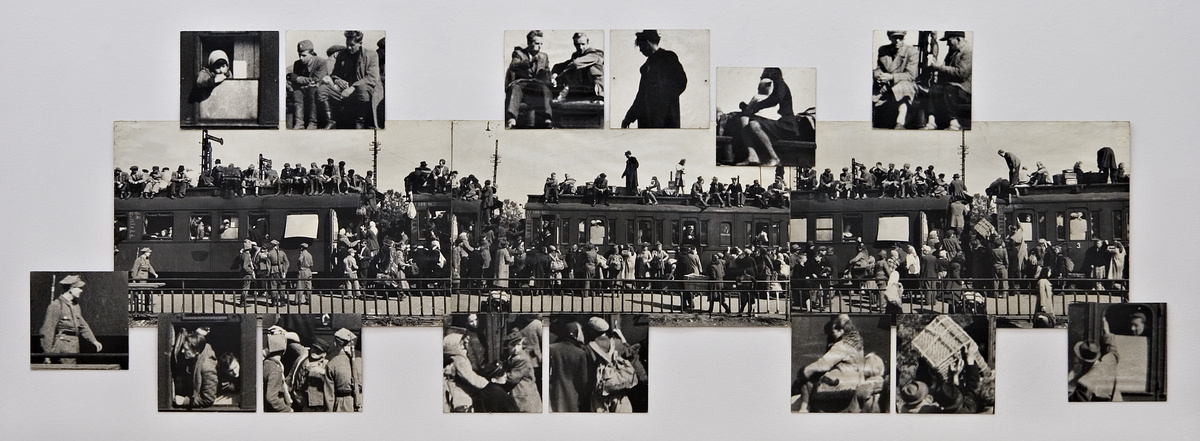
Cover Image: Jerzy Lewczyński, Nasze powiększenie / Nysa, 1945