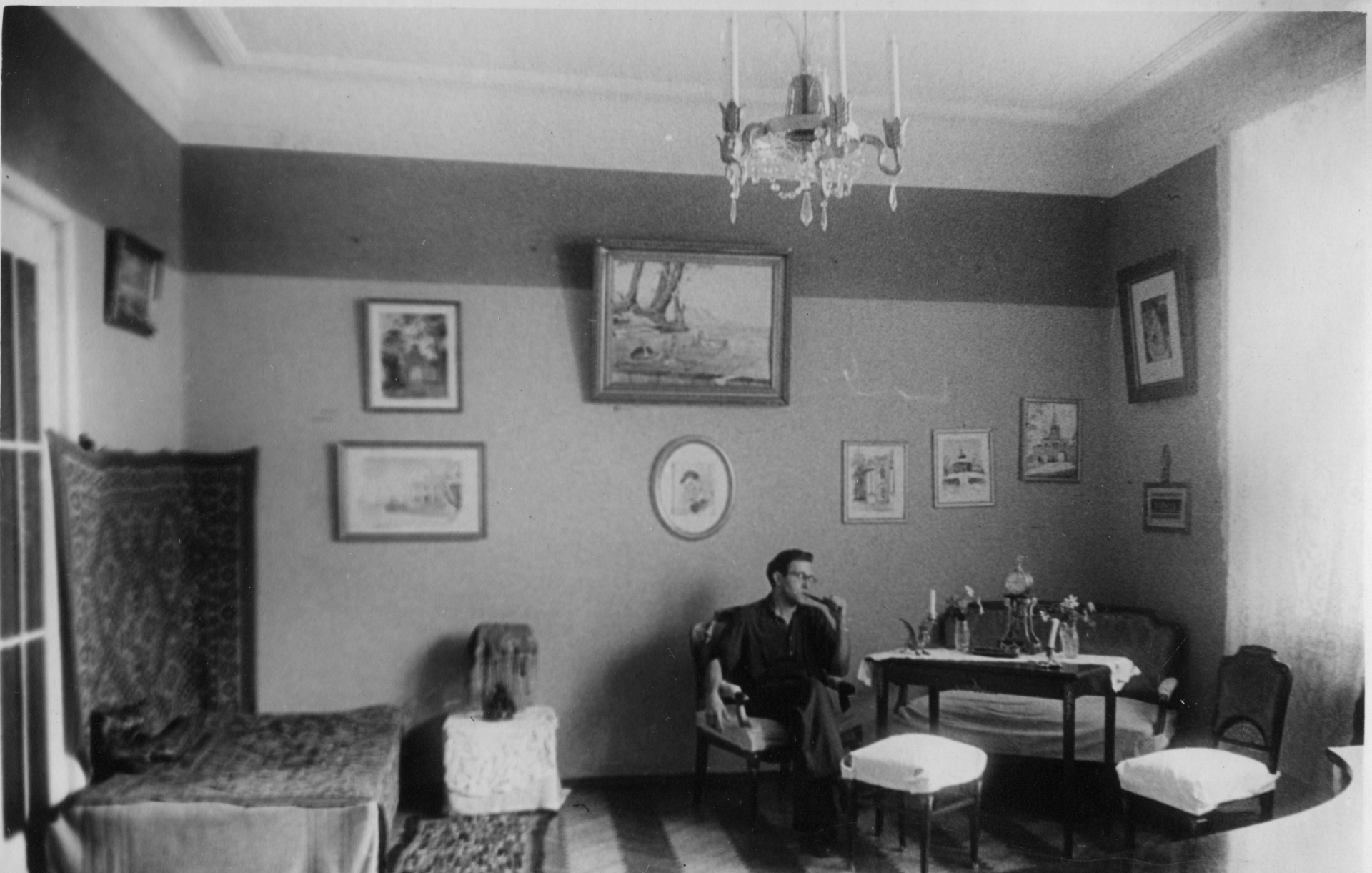
In the Architects' Rooms


April-June 2026
"Vitalnia" Café and Center's conference room, 6 Bohomoltsia St.
The residential building at the intersection of Rustaveli Street and Petrushevych Square, often considered an example of Polish functionalism; the "Sputnik" restaurant in Stryisky Park; the "Dnister" and "Lviv” hotels; the student cafeteria of the Academy of Arts, and the fourth building of Lviv Polytechnic—are buildings that, in one way or another, are recognizable and form part of the architectural fabric of postwar Lviv. Behind them, in particular, lie the names and work of Anatolii and Muza Konsulovs.
In 2018, the Urban Media Archive of the Center for Urban History, together with the architects' granddaughter, Kateryna, began digitizing and processing the Konsulovs' private archive. Recently, the Media Archive team completed the meticulous work of structuring and cataloging the collection. The archive contains information on both practical and theoretical work and is unique in its scope and composition. It includes numerous photographs, negatives, drawings, sketches, and texts from the family, as well as sketches and plans for buildings designed with the participation of Anatolii and Muza Konsulovs' students. However, the collection, as well as the professional and personal trajectories of the family of architects, remains unexplored and requires further thorough research.
Through the photographs presented in the exhibition, we raise the question: what is the private archive of architects? Like its creators or researchers, it does not exist in a vacuum. An architect's portfolio is shaped not only by buildings and drawings, but also by broader political contexts, professional environments, and individual decisions. At the same time, private interactions with family, friends, colleagues, and students, or leisure planning, are not the first things that come to mind when discussing the study of architects’ archives.
In the exhibition "In the Architects' Rooms," we unpack only a small part of this multi-layered collection, revealing the private, working, and conceptual spaces of Anatoliy and Muza Konsulovs in photographs of living rooms where the architects lived or hosted guests, workshops where they created and met with friends and colleagues, as well as in interior sketches. Each of them encourages us to contemplate: What and how shaped and inspired, but also determined the architects’ professional style? What can archival photographs of the family’s home on Tudor Street (now Levynskyi Street) or the studio-workshop on the technical floor of the newly built house on Budivelna Street (now Rodyny Krushel'nyts'kykh Street) tell us? How does architecture become an integral part of not only professional but also private life? Who compiles and organizes architects' archives, and what insights do they provide for research? Ultimately, who decides which materials from a private archive should be made public?
The exhibition will take place as part of the Center for Urban History's public program [unarchiving].
The exhibition has been prepared by:
- Oksana Avramenko, Mykyta Bilyi, Yelyzaveta Bobrova, Sofia Dyak, Oleksandra Kliushnichenko, Sofia Nazaruk, Mariana Mazurak, Viktoriia Panas, Yaryna Paniv, Anastasiya Kholyavka / Center for Urban History
- Oleksandra Davydenko, Taras Karpiv / "Vitalnia" and "Tovarystvo" Cafés
- Kateryna Malaya, author of the text on interior sketches
- Sofia Bylym, preparation of materials for publication
- “Kleinod” Print Shop
Credits
Cover Image: Anatolii Konsulov in his studio, 1960s–1980s, Lviv / collection of Kateryna Konsulova / Urban Media Archive of the Center for Urban History