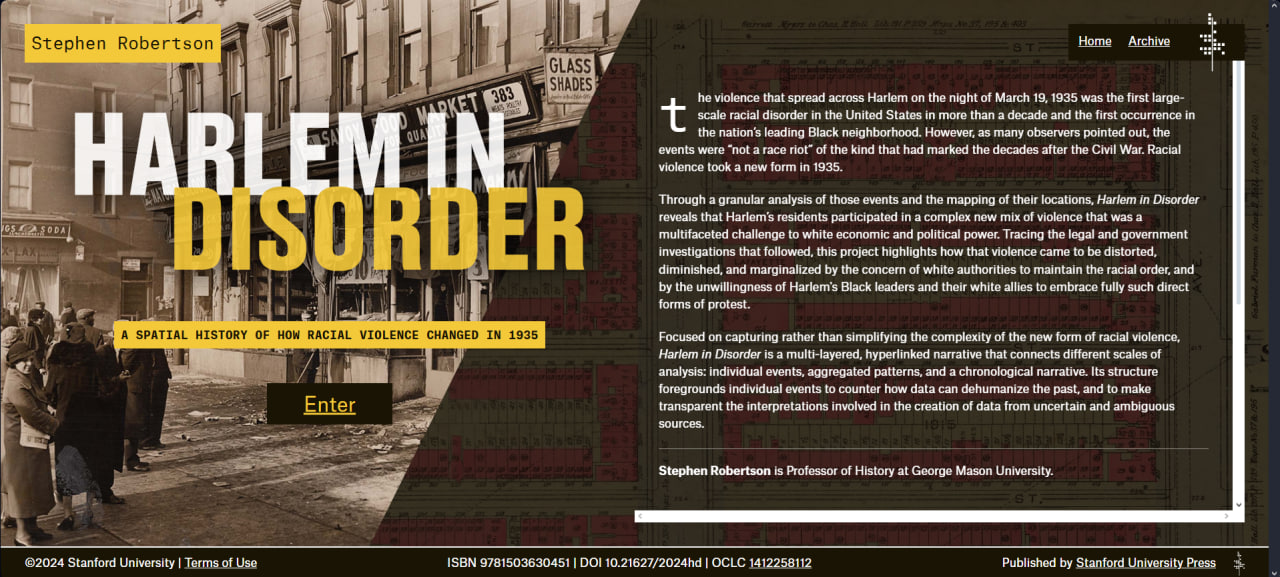
History Unbound: Harlem in Disorder as an Example of Using the Digital Medium to Present Evidence and Context


Stephen Robertson
20.11.2025, 18:00
online / Zoom
Historians' shift to digital research practices makes it necessary to consider the form of their publications. The increasingly large amounts of information produced by such research, and the need to put search results in context, make necessary a change in how scholarly claims are established. Existing techniques for presenting evidence that rely more on trust than documentation are also inadequate for distinguishing scholarship from the output of machine learning algorithms and AI chatbots. The digital medium offers ways to incorporate evidence and different media, and to weave form and content together beyond what is possible in print formats.
Harlem in Disorder is one example of a publication that used the digital medium to create a form that fits the research and argument. Capturing rather than simplifying the complexity of a new form of racial violence required a multi-layered, hyperlinked narrative that connects different scales of analysis: individual events, aggregated patterns, and a chronological narrative. This structure foregrounds individual events to counter how data can dehumanize the past, and to make transparent the interpretations involved in the creation of data from uncertain and ambiguous sources.
This presentation will discuss how Harlem in Disorder was conceived and developed. It will explore how the immersive and interactive features of the digital medium offer possibilities for reimagining the monograph. It will also consider how digital forms of publication can be used to tell the story of the data used in digital history projects.
The event will be launched online. To receive an invitation to participate in events, please contact Sofia Andrusyshyn via email: s.andrusyshyn@lvivcenter.org.ua. The presentation will be in English with simultaneous translation into Ukrainian.
Professor of History at George Mason University. Associate Director at the Roy Rosenzweig Center for History and New Media. Co-creator of Digital Harlem, an online research tool that maps the complexity of everyday life in a 1920s neighborhood. A social and digital historian of the 20th century United States, his current research maps and analyzes undercover investigations in the period from the Civil War to WW2 and explores the role of civil and criminal law in the suburbs from 1945 to 1980. He also writes about the possibilities and uses of digital methods in historical research and publication.
Stephen Robertson
The event will take place within a series of seminars and workshops around specific cases of urban history digital platforms/projects, "Urban History Digital Infrastructures: Sharing Expertise and Networking Cities", organized by Center for Urban History, with the support of the Center for Governance and Culture in Europe at the University of St.Gallen.