Debora's Circle


2025-2026
Lviv
We invite you to a series of city walks called "Debora's Circle", organized by Inna Zolotar.
Lviv between the Great Wars was not a city comfortable for people of “other” backgrounds, for intellectuals who sympathized with the “wrong” political movements, or for women who wanted to realize themselves professionally. It was a time of political and social tension, a difficult economic situation, and difficult elections. At the same time, it was a time of bold ideas, heated discussions, original discoveries, and new opportunities.
Such periods were the time when interesting and complicated biographies were living. And thanks to people with interesting and complicated biographies, Lviv emerged in the interwar period as an important center of science and a place where new art was born. Due to the radical change in the city's population after World War II, most of these stories disappeared from urban space and memory.
One such biography is that of Deborah Vogel. She is no longer an unknown figure in Lviv. Her name began to return to Lviv more prominently, at least in the 2010s. She returned in the research and artistic projects of Karolina Shymaniak, Andrij Bojarov, and others, and in translations by Yurko Prokhasko. In 2017, the Museum of Ideas hosted a multimedia exhibition dedicated to her, Puzzles of Memory, accompanied by a discussion and a musical performance. At the Space of Synagogues memorial, one can read a line from her prose collection of literary montages, Acacias Bloom.
However, despite the presence of Debora Vogel in professional discussions and conversations about artistic biographies of Lviv, her topographical absence in the city is obvious. None of the attempts to name a street, square, or any other space in the city after Debora Vogel have been successful so far. There are also no plaques on the buildings that belonged to her family or are associated with her biography.
However, it is not known whether Debora Vogel would have been comforted by such traditional ways of commemorating her. As one of the first women with a doctorate, a connoisseur of literature and contemporary art who saw, heard, and wrote about the city differently, her biography has little tradition, but a lot of novelty and courage. Therefore, perhaps, Debora's return to the city's spaces should be special, "Vogelian," unconventional.
An unconventional way to remember Deborah Vogel is the walk "The City in the Rhythm of Debora Vogel," which brings her texts back to the city, allows us to look at Lviv through Vogel's eyes and from the perspective of her time, helps us to feel the pace and rhythm of the poet and imagine our heroine in space, telling her extraordinary biography through her environment and memory.
Another walk "Rachel Auerbach. Lviv Chronicles" brings Vogel's closest friend, Rachel Auerbach, back to the spaces of Lviv. She is known primarily as the author of the Warsaw Ghetto Chronicles, one of the three members of Dr. Ringelblum's Oneg Shabbat group who survived the Holocaust. Less visible and relevant is her work with witnesses and testimony during the Eichmann trial in Jerusalem. And the Lviv part of Auerbach's biography as a public intellectual associated with the philosophical and mathematical school of Kazimierz Twardowski, the Yiddish-language magazine Tsushtayer, and the avant-garde literature and art community is almost completely unknown. It was in Lviv that Rachel Auerbach would publish her first poems, write many articles, meet like-minded friends and get acquainted with people who changed the artistic and literary landscapes, and prove herself as a skillful organizer of educational and publishing processes, a professional lecturer, and editor.
Rachel Auerbach came to Lviv in the 1920s and left the city for good in the 1930s. Here she studied, worked, made friends, and tried to create a new Yiddish-speaking intellectual environment. A walk through Rachel Auerbach's Lviv addresses highlights her life paths and crossroads, the history of her family and community, and the choices and challenges of Lviv residents at the time. In addition, the walk helps to see the role of Lviv in the creation of the system of international law and emphasizes the existence and continuity of the tradition of working with the testimonies of World War II survivors.
The stories of both of our heroines will always be incomplete without the communities that shaped them and the environment that influenced and was influenced by both Deborah and Rachel. That is why the third walk, "Debora's Circle", reminds us of Kazimierz Twardowski's School of Philosophy and Mathematics at Lviv University, with which our heroines had different relationships. “Debora's Circle” puts the creators and inspirers of Yiddish culture in predominantly Polonized Jewish Lviv back on the map of Lviv. This walk also recalls the activities of the very colorful, avant-garde artes group, whose work shows the many connections between Ukrainian art and the Polish environment.
Now, in times of war, Ukraine is trying to tell the world about itself in different ways. Some of them are exhibitions and books. However, artists or writers from interwar Lviv, especially those of non-Ukrainian origin, are hardly represented. The three walks through Lviv remind citizens, visitors, and Ukrainians in general, of a different Lviv, the memory of which was erased after World War II. Deborah Vogel's poetry and texts, Rachel Auerbach's articles and human rights activism, and the works and biographies of the artistic, literary, and scientific community are our heritage. This heritage can sustain us, help us ask questions, set the trajectory for finding answers, and show us the not always obvious connections between Ukraine and the rest of the world that we are so eager to tell about ourselves. However, the condition and visibility of this heritage is our responsibility. And it is worth seeing, hearing, and showing to the world.
PROGRAM
- The City in the Rhythm of Debora Vogel / 3.5.2025, 21.6.2025
- Rachel Auerbach. Lviv Chronicles / 26.7.2025, 18.10.2025
- Debora's Circle / spring 2026
The city walks are part of the "Weaving the Heritage" series, which is a public program of the "REHERIT 2.0: Common Responsibility for Shared Heritage" project. "REHERIT 2.0 is implemented by the Center for Urban History and the Regional Development Center of the PPV Economic Development Agency with the financial support of the European Union.
This publication was created with the financial assistance of the European Union. Its content is the sole responsibility of the partners of the "REHERIT 2.0" project and does not necessarily reflect the views of the European Union.



Credits
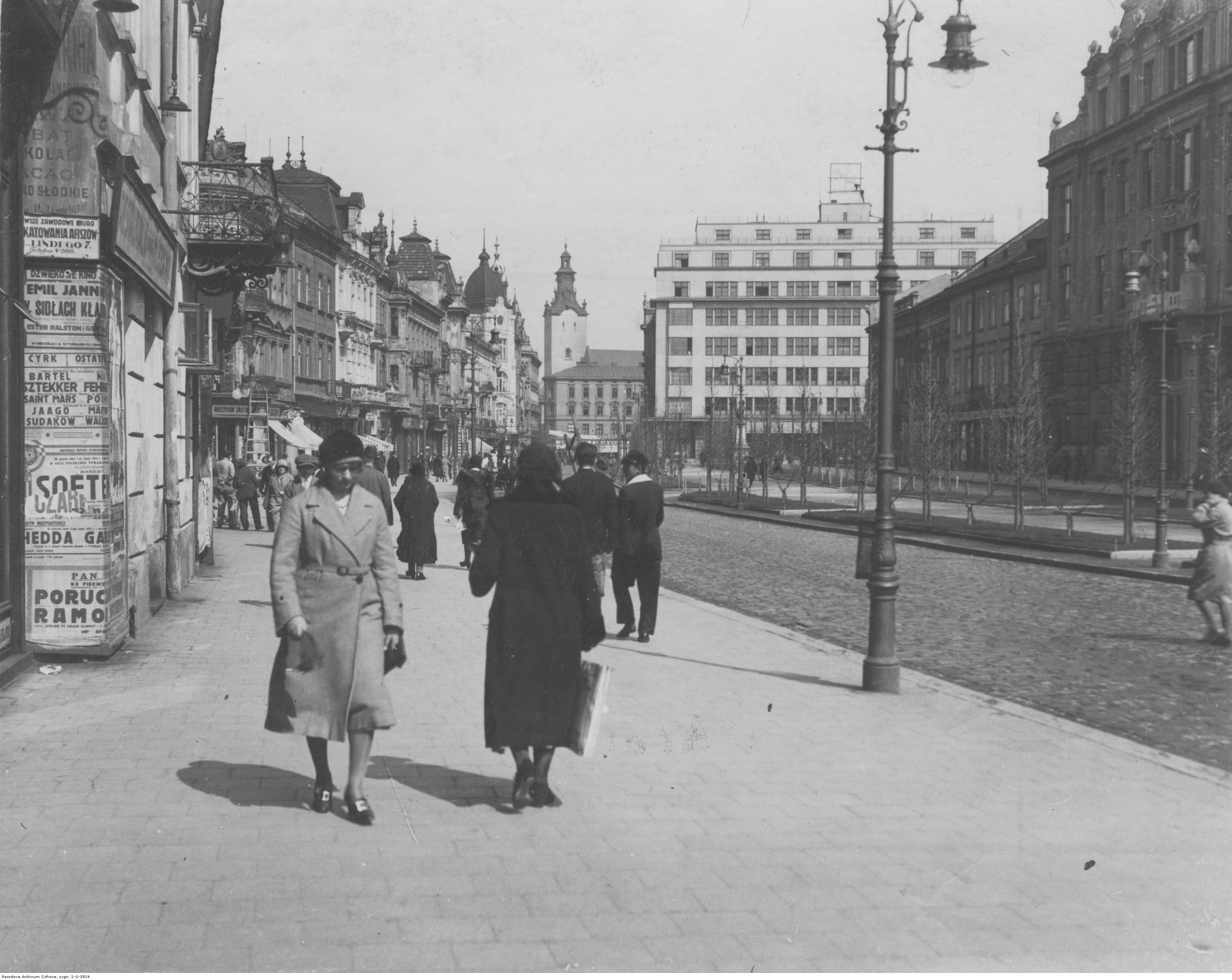
Cover Image: Academichna street in Lviv, 1925-1939 / Koncern Ilustrowany Kurier Codzienny – Archiwum Ilustracji, 1-U-3524 / Narodowe Archiwum Cyfrowe