"I survived the Nazis, I will survive the Rashists": The Second World War and the Holocaust in the Current Ukrainian Discourse on the Ongoing Russian Invasion


19.9.2025
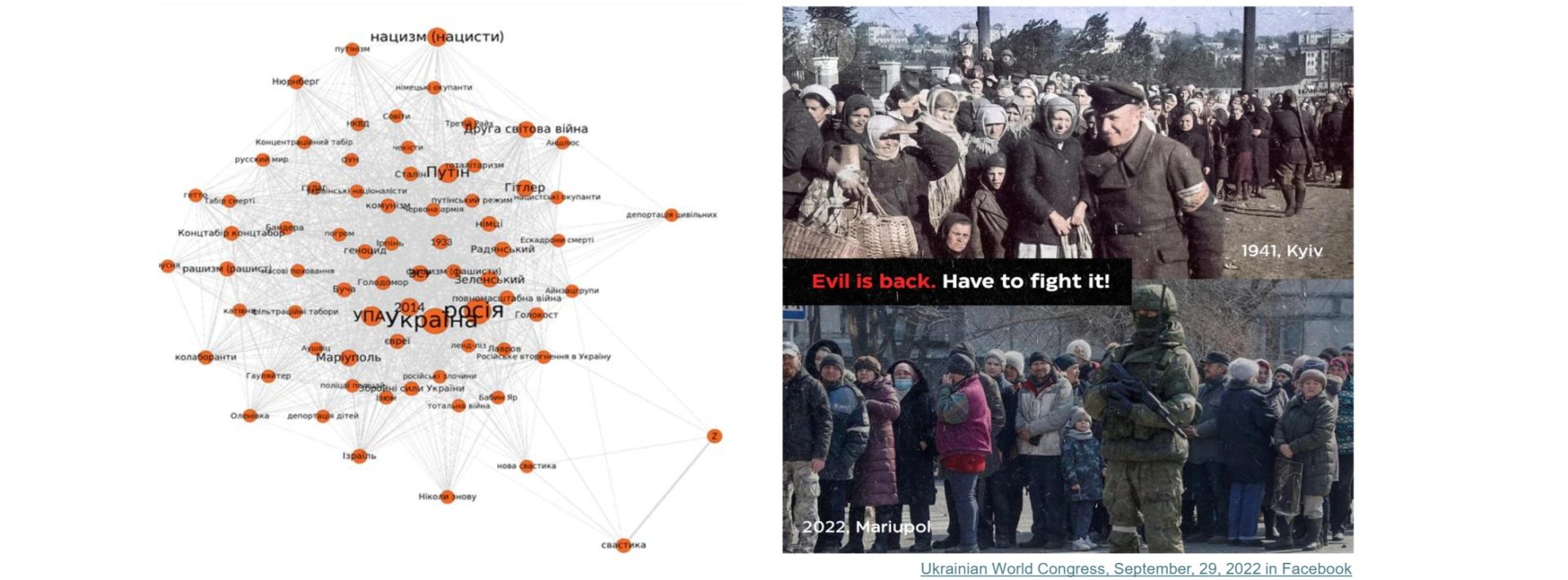
Ukrainian public discourse on the full-scale Russian invasion features a certain distinctive trait – the tendency to compare this war to the Second World War and the Holocaust. Such comparisons did not emerge spontaneously in 2022, they were utilized before and originated in 2014, however, their prevalence after 24th February forms a separate discoursive pattern, recognized as such both in Ukraine and abroad.
The seminar will be devoted to presenting and discussing our research project, which aims at analyzing and interpreting various forms of such historical analogies in the Ukrainian public discourse in order to establish how visual and textual parallels shape the narratives on the ongoing war — and, simultaneously and mutually, the collective memory of the past events. We are interested in the role that historical analogies play in the construction of the past, understanding the present and imagining the future, how they impact decision-making processes, education, public policies, etc.
A unique feature of this research project, funded by the Foundation for Polish Science within the frames of the FOR UKRAINE Programme, is an extensive database and archive of such historical analogies, consisting of 65 000 entries (both textual and visual), automatically harvested from the entire Ukrainian-language internet (all major social media, web portals, and YouTube) for the period between 24.02.2022-24.02.2023, so published during the first year of the full-scale invasion. This body of sources is being analyzed qualitatively, quantitatively and with AI-assisted methodologies (Topic Modelling).
During the public presentation of the research results, we invite you to discuss how historical analogies are present in our understanding of today's events, as well as how this affects the remembrance of World War II and the Holocaust as such, and what such commemorative slogans as "Never again" mean for the collective memory of the past events.
Speakers
Paweł Dobrosielski — Ph.D., culture studies and philosophy graduate, English language translator, Assistant Professor at the Institute of Polish Culture, University of Warsaw, Poland. The author of a monograph Spory o Grossa. Polskie problemy z pamięcią o Żydach, Instytut Badań Literackich PAN, Warszawa 2017 and co-author and co-editor of a collective monograph Ślady Holokaustu w imaginarium kultury polskiej, Wydawnictwo Krytyki Politycznej, Warszawa 2017. Leader of the research project "I survived the Nazis, I will survive the Rashists": The Second World War and the Holocaust in the Current Ukrainian Discourse on the Ongoing Russian Invasion.
Yevhen Zakharchenko — Associate Professor at V. N. Karazin Kharkiv National University. Lecturer of the courses "Historical Politics in Ukraine" and "The Holocaust: Politics of Memory and Representation," participant in international projects, scholarship programs, and seminars in the field of memory studies in the United States, Austria, and Poland.
The event is part of a project organized by the Institute of Polish Culture, University of Warsaw, Department of History of Ukraine V. N. Karazin Kharkiv National University and the Center for Urban History.
The project is supported by the Foundation for Polish Science.
Patronage: Consulate General of the Republic of Poland in Lviv.