Understanding Modernity: Series of Workshops on Sources and Approaches to Teaching the History of Ukraine and (Eastern) Europe


January - December 2026
We invite you to participate in a long-term program of seminars and workshops devoted to methodological challenges in teaching the modern period of European history through the prism of the experience of Ukraine and Eastern Europe. The program is planned as a multi-year one and will consist of separate annual series of workshops around different topics.
At the center of the entire program will be the question of how to teach and explain the complex, contradictory, and multidimensional processes of historical transformations of the last two centuries: the rise and fall of empires, the formation of nation-states, the causes and logic of large-scale wars, the differences in modernization projects, the specifics of socialist experiments, and the longevity of their legacies. The program will focus on working with sources, reviewing key theories of explaining modernity, and teaching methods and approaches. Throughout each year-long series, participants will discuss topics that have shaped the trajectories of modern Europe: changing notions of progress and the effects of its exhaustion, experiences of violence, revolution and war, cycles of destruction and reconstruction, imperial legacies, and the nature and consequences of the Soviet socialist project. By placing an Eastern European perspective and Ukraine's historical experiences at the center, the series aims to rethink established narratives of modernity and Europeanness and to stimulate interdisciplinary dialogue about how these histories can be taught and interpreted within and beyond national canons. Five annual series are planned, with a separate call for participants for each of them.
The first series, which will begin in 2026, will focus on approaches to teaching "Soviet" and "socialist" as historical periods, experiences, ideologies, and sets of political, economic, and cultural practices. The socialist appears as a broad intellectual paradigm that encompasses a variety of political and social projects and goes far beyond the boundaries of a single state entity. Instead, the Soviet model was a specific historical realization of the socialist idea in the USSR with its own institutional logic, disciplinary mechanisms, and practices of power. Relations between the socialist countries and the Soviet federation were not easy: alongside the "Soviet" model, there were alternative models, such as democratic or liberal socialism, anti-colonial socialist movements, and so on. The Soviet project had distinct imperial structures of power, hierarchies of center and periphery, practices of inequality and cultural assimilation. Instead, many currents of the socialist tradition were inherently anti-imperial, supported international solidarity, and stimulated decolonization movements.
The aim of the first series of workshops is to create a space for critical discussion and rethinking of the challenges faced by teachers of history, cultural studies, sociology, anthropology, and other related disciplines for which the "Soviet" and/or "socialist" are key objects of research and pedagogical practice. The series will combine interdisciplinary discussion with the development of practical teaching materials. The final result will be a generalized syllabus prepared by the participants and a set of educational resources (primary sources, modules, teaching materials) that will be made available for public use on the REESOURCES educational platform.
Format
The series will consist of five one-day offline workshops that will take place throughout the year at the Center for Urban History or one of the partner universities in Ukraine. During the meetings, a group of 10-12 selected participants will work on developing teaching materials and creating a generalized silhouette that we hope will become a useful resource for teachers across Ukraine.
Who we are inviting
University professors, historians, sociologists, cultural studies, anthropologists; experienced and young researchers who work with the Soviet period of history in their research or teaching practices or for whom Soviet and/or socialist history is a subject of professional interest.
Duration
January–December 2026.
Language of work
Ukrainian.
Organizational support
The organizers cover the logistical costs and accommodation of the participants during the workshops. Author's fees are provided for the training materials prepared within the series. The first workshop is scheduled for late January — early February 2026. The exact date will be agreed with the participants in advance. The dates of subsequent meetings will also be determined in cooperation with the group.
To apply, please fill out the application form. Please attach your CV to the application form. Deadline: December 28, 2025
The series of workshops is organized by the Center for Urban History in partnership with V. N. Karazin Kharkiv National University, Uzhhorod National University, O. Honchar Dnipro National University, Ukrainian Catholic University, Izmail State Humanitarian University, Y. Fedkovych Chernivtsi National University, Vinnytsia Mykhailo Kotsiubynskyi State Pedagogical University, Taras Shevchenko National University of Kyiv.
Credits
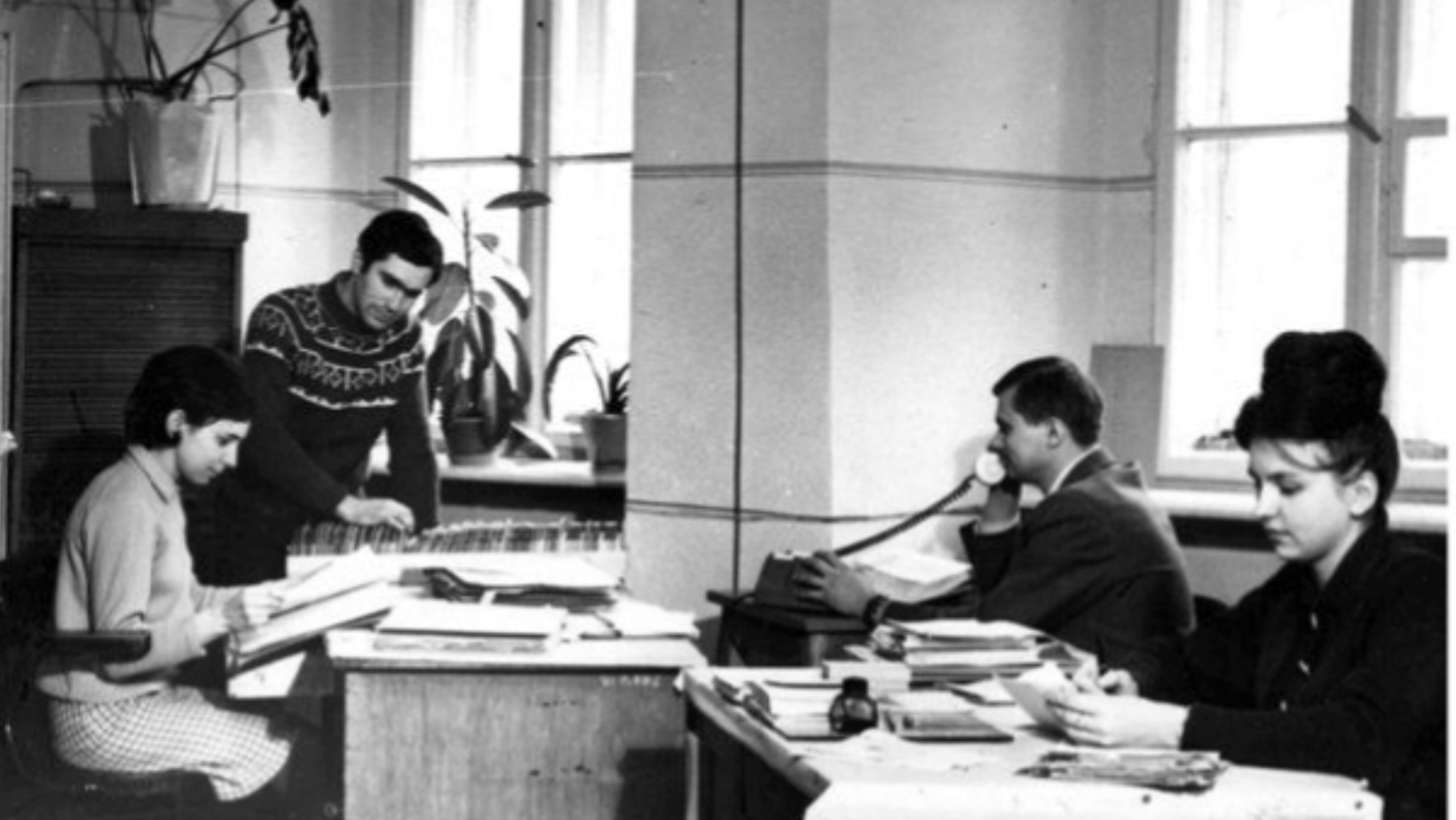
Cover Image: Staff office in the State Archive of Lviv region, Lviv, 1960-1970s / collection of Ihor Kalynec / Urban Media Archive of the Center for Urban History