Spaces of the Holocaust: Occupation Regimes, Borders, and Local Experiences on the Territory of Ukraine


10-11.12.2026
Lviv
The history of the Holocaust on the territory of Ukraine is one of the most dynamic areas of research. Its polycentric nature reflects not only the development of research infrastructure—universities, archives, museums, and new research centers—but also the complexity of the historical experiences of war, occupation, and persecution themselves. During World War II, different parts of present-day Ukraine were under the control of various occupation administrations, resulting in distinct legal regimes, persecution practices, mechanisms of displacement and deportation, as well as local conditions for survival and rescue.
The Holocaust on the territory of Ukraine unfolded in various spatial and political contexts: in the ghettos of the District of Galicia, which was incorporated into the German General Government with its center in Kraków; in the deportation camps and ghettos of the Romanian-occupied zone of Transnistria; at sites of mass shootings in cities, towns, villages, ravines, and suburbs of the Reichskommissariat Ukraine and in frontline zones controlled by the Wehrmacht; in territories under Hungarian administration, where mass deportations took place in the spring of 1944; and finally, in the system of concentration camps and "death marches" toward the end of the war.
This diversity raises the question of how to study the Holocaust not only within the borders of individual regions or occupation administrations, but also beyond them. A transregional and trans-occupational perspective allows us to see how practices of persecution, deportation, forced labor, mass murder, survival, and rescue varied depending on the political and administrative context. At the same time, this approach helps us view borders not only as dividing lines between occupied zones, but also as spaces of movement, interaction, escape, persecution, and the transfer of experiences.
The field of Holocaust studies is characterized by great methodological diversity and offers many innovative perspectives. Local studies and microhistorical approaches are of particular importance. These approaches allow us to reconstruct the experiences of individuals, families, communities, and local groups within the context of broader political decisions and mechanisms. Combining microhistory with a trans-occupation perspective makes it possible to simultaneously explore the specifics of a particular place and trace the connections between various local and regional contexts, which in turn will allow us to (re)define and (re)interpret broader interpretive and narrative frameworks. Holocaust studies increasingly intersect with research on marginalized groups—children, people with disabilities, and the elderly; the history of mass graves is linked to environmental history; and emotions and memories become the focus of research. Digital humanities methods are gradually becoming an integral part of both the research process and the presentation or illustration of results.
A significant challenge is the multilingual nature of the history of the Holocaust in Ukraine. Sources—ranging from occupation decrees, administrative documentation, and court records to letters, diaries, and testimonies of those who lived through and perished during the occupation—are written in Ukrainian, Yiddish, Polish, Romanian, German, Hungarian, Russian, and other languages. Accordingly, Holocaust research in Ukraine is developing within various historiographical and disciplinary traditions. The geography of these historiographies includes, but is not limited to, works published in Ukraine, Poland, Romania, Germany, Hungary, Israel, the United States, France, and other countries. Overcoming linguistic, disciplinary, and historiographical boundaries is an important prerequisite for creating a more comprehensive history of the Holocaust in Ukrainian territories. This perspective allows us to connect local experiences with regional history, the history of the Holocaust in Ukraine, and the broader context of World War II and European history.
The conference aims to create a space for professional discussion among researchers, museum professionals, and archivists working on the history of the Holocaust in Ukraine. We warmly welcome early-career scholars, postdoctoral researchers, and advanced PhD students to apply. In particular, we encourage proposals that employ approaches from social history, the history of emotions, microhistory, gender and minority studies, digital humanities, and studies of memory and memorialization.
We invite submissions of papers focusing on the following topics:
- The dynamics of violence under different occupation regimes: changes in social reality as occupation authorities change; the geography and intensity of violence; the formation of a new reality and adaptation to violence; strategies of adaptation, adjustment, and resistance.
- Borders and their functioning: various types of borders—from occupation zones to ghetto boundaries; processes of border establishment and the material dimension of borders; regimes of movement and restrictions on mobility; experiences of and perceptions regarding borders; bodily experiences of crossing borders; life on the periphery of occupation zones.
- Microhistory of ghettos: spatial and social transformations of cities and towns with the establishment of ghettos; daily life in the ghettos; hiding and rescue; the movement of property and belongings, expropriation, theft, and blackmail; the political and economic role in occupied territories; a comparative analysis of ghettos in different zones of occupation.
- Marginality and marginalization: vulnerable population groups under conditions of total violence; the experiences of children and the elderly during times of mass violence; gender-based violence, sexual violence; experiences that are rarely visible or are silenced; the processes of exclusion and marginalization.
- Collaboration: motivations, social practices, and the limits of complicity; the line between adaptation and complicity in crimes.
- Saved by distance: experiences of deportation, evacuation, and flight; stories of return and reintegration; the formation of new communities; postwar silence.
- Information, communication, and dehumanization: the impact and importance of the information landscape under occupation; propaganda and the shaping of a new social reality; the spread of rumors; access to radio and the problem of the information vacuum.
- Religious communities and spaces: the destruction of religious buildings and institutions; forms of violence against religious communities; religious interpretations of suffering and endurance.
- Individual trajectories and agency: the personalization of experiences of mass violence and individual stories in Holocaust narratives; the potential of the collective biography method; the concept of agency in the context of mass violence.
- Testimonies, emotions, memory: the temporal trajectory of testimonies, the contexts of acts of testimony and their use; the multiplicity of forms and media of testimony: from oral and literary to visual, auditory, and cinematic; emotional modes of testimony, listening, and working with testimonies; the diversity of practices and methods of remembrance, commemoration, and the transmission of memory; experiences of museums and spatial projects.
- Digital history and public databases: digitization of archives; digital and public history; projects mapping Holocaust sites; digital history as an opportunity and a challenge for education and research.
- Methodological challenges: the problem of a lack of sources and their preservation; taboo and political sensitivity; local experiences of the Holocaust and national grand narratives (for example, the Holocaust in Northern Bukovyna or Transnistria from the perspective of the national narratives of Romania and Ukraine, or the Holocaust in Galicia from the perspective of the national narratives of Poland and Ukraine); the interdisciplinary nature of Holocaust studies.
The application must include:
- A description of the presentation topic (up to 500 words)
- CV
Please submit applications as a single PDF file to conferences@lvivcenter.org with the subject line "Spaces of the Holocaust" by September 15, 2026. Notifications of acceptance will be sent by October 1, 2026. We expect participants to submit a draft of their paper or presentation notes by November 25, 2026.
The working language of the conference is Ukrainian, with some panels held in English, for which simultaneous interpretation will be provided.
The organizers will cover travel and accommodation expenses for all participants who are not funded by their institutions.
Organizing Committee:
- Sofia Dyak, Center for Urban History
- Ulyana Kyrchiv, Mykola Haievoi Center for Modern History at UCU
- Iryna Klymenko, Research Centre Ukraine / Max Weber Foundation
- Maryana Mazurak, Center for Urban History
- Vladyslava Moskalets, Center for Urban History
- Artem Kharchenko, Center for Interethnic Relations Research in Eastern Europe
- Pavlo Khudish, Uzhhorod National University
Co-organizers:
- Center for Urban History (Lviv)
- Center for Interethnic Relations Research in Eastern Europe (Kharkiv)
- Uzhhorod National University (Uzhhorod)
- Research Centre Ukraine / Max Weber Foundation (Lviv)
The conference is supported by EHRI-ERIC and is part of the development of the EHRI-UA network.



Credits
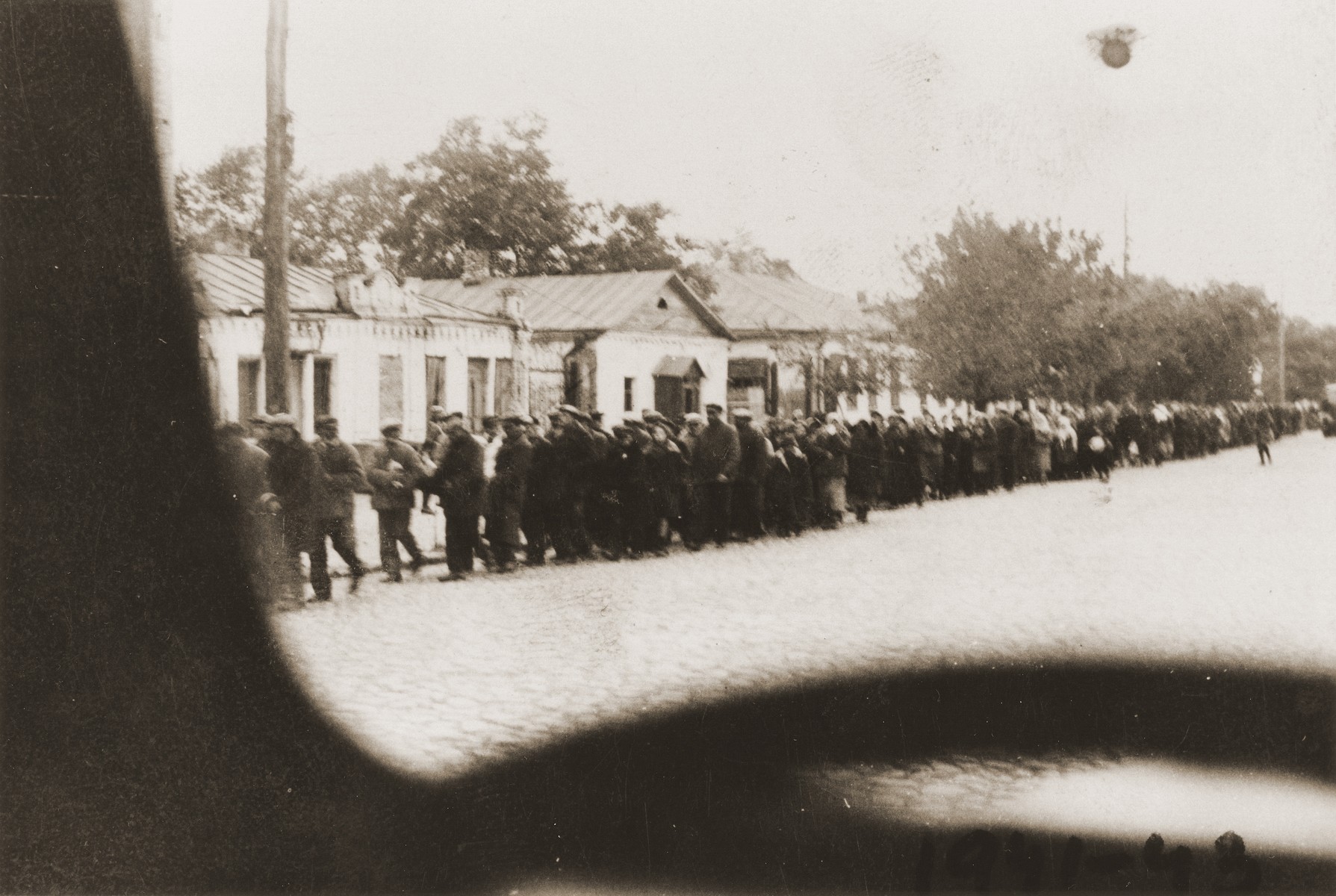
Cover Image: Jewish deportees under German guard march through the streets of Kamenets-Podolsk to an execution site outside of the city, August 27, 1941 / photographer Gyula Spitz / provenance: Ivan Sved / United States Holocaust Memorial Museum