Overlooked: Online Research Seminars on the History of the Ghettos


April – December 2026
online / Zoom
This series is situated at the intersection of the histories of violence, society, and its actors, infrastructure, propaganda, and responsibility. It aims to reconsider current historiographical paradigms and approaches to studying the history of ghettos by looking at different, often understudied, occupation zones in Nazi- and Nazi-allies occupied Europe. A particular focus will be on the territories of contemporary Ukraine, Poland, Lithuania, Moldova, and Belarus, with the cases in the on eastern parts of the Generalgouvernement (the District of Galicia), Reichskommissariat Ostland (the Generalbezirk Litauen), the General District of Volyn-Podillia within the Reichskommissariat Ukraine or Transcarpathia and Transnistria, occupied by the Kingdom of Hungary and the Kingdom of Romania, respectively. Exploring different cases and research experiences, the seminar will ask how historiographies can produce blind spots; how dominant structures and perspectives define what is considered central, what is peripheral or marginal, and what goes entirely unaccounted for, or, indeed, overlooked; and how the outlines of future research could look.
For a long time, the focus of scholarly interest in the ghettos as a core part of Holocaust history has mainly remained on several large ghettos within the General Government (Generalgouvernement), especially on the Warsaw Ghetto, the largest and most extensively documented ghetto. While crucial and important, such a focus led to the neglect of the different experiences of genocidal practices that occurred in smaller ghettos or under different occupational regimes established by Nazi Germany and Nazi-allied countries. Over the last two decades, we have gained a deeper understanding of ghettos in major cities of Central Europe, such as Budapest (Cole, 2003) and Theresienstadt (Hajkova, 2020). Also, there is a growing understanding of the importance of studying ghettos in smaller towns, and new publications are appearing, for example, about the ghettos in Tarnów (Wierzcholska, 2022) or in Zdolbuniv (Dolhanov, 2024).
The seminar aims at an interdisciplinary dialogue between historians and sociologists, investigating the untold Holocaust histories from Kaunas to Odesa through both "top-down" and "bottom-up" approaches, will provide a fruitful entry point for gaining a better understanding of the different trajectories of ghetto establishment, functioning, and destruction. Taking a "bottom-up" approach allows us to trace the diverse dynamics of Nazi anti-Jewish policies and the entangled relations with non-Jewish residents and neighbors, including the latter's involvement in the mass murder of Jews. These online meetings will provide a space for dialogue and the challenging of paradigmatic concepts, with the aim of developing new insights inspired by the latest research conducted in this region. One of the main objectives of this seminar series is to develop new concepts and methods for interpreting known and new primary sources.
The seminars will take place between April and December 2026, in the form of regular monthly meetings. These meetings focus on the latest methodological developments and research proposals or projects.
In 2026, the following sessions are planned as follows:
-
April 29 / Natalia Aleksiun (University of Florida), Writing the Lwów Ghetto: Philip Friedman and the Constraints of Early Holocaust Historiography / Moderator: François Guesnet (UCL)
-
May 27 / Agnieszka Wierzcholska (Sciences Po), The Diversity of Ghetto Experiences – The Case of the Tarnów Ghetto / Moderator: Nataliia Ivchyk (USHMM)
-
July 15 / Marie Moutier-Bitan (EHESS), Along the Dniester: Ghettos, Transit Camps, and the Dynamics of Deportation / Moderator: Ana Bǎrbulescu (Elie Wiesel Institute)
-
September 23 / Anna Hájková (University of Warwick), An inclusive history of the victim society: writing about everyday life in Theresienstadt / Moderator: Katarzyna Person (Warsaw Ghetto Museum)
-
November 4 / Pavlo Khudish (Uzhhorod National University), Everyday Life in "Small Ghettos": Protecting and Sharing the Memory of the Holocaust and the Genocide of the Roma in Transcarpathia / Moderator: Liana Blikharska (Center for Urban History)
-
December 9 / Simon Goldberg (USHMM), Writing the Kaunas Ghetto: Power and the Production of Jewish Holocaust History / Moderator: Nadia Skokova (Center for Urban History
Please note that the seminar time varies by time zone: 15:00 CET / 16:00 EEST / 9 AM EST.
To participate, please fill out this this form.
This series follows the workshop held in Lviv in October 2025, Overlooked: Revisiting the Histories of Ghettos in Occupied Territories of Contemporary Ukraine, Poland, Lithuania, and Moldova.
The online seminars are part of the Research Alliance between the Center for Urban History (Lviv), Research Centre Ukraine / Max Weber Foundation, (Lviv / Bonn) and Warsaw Ghetto Museum (Warsaw).
Credits
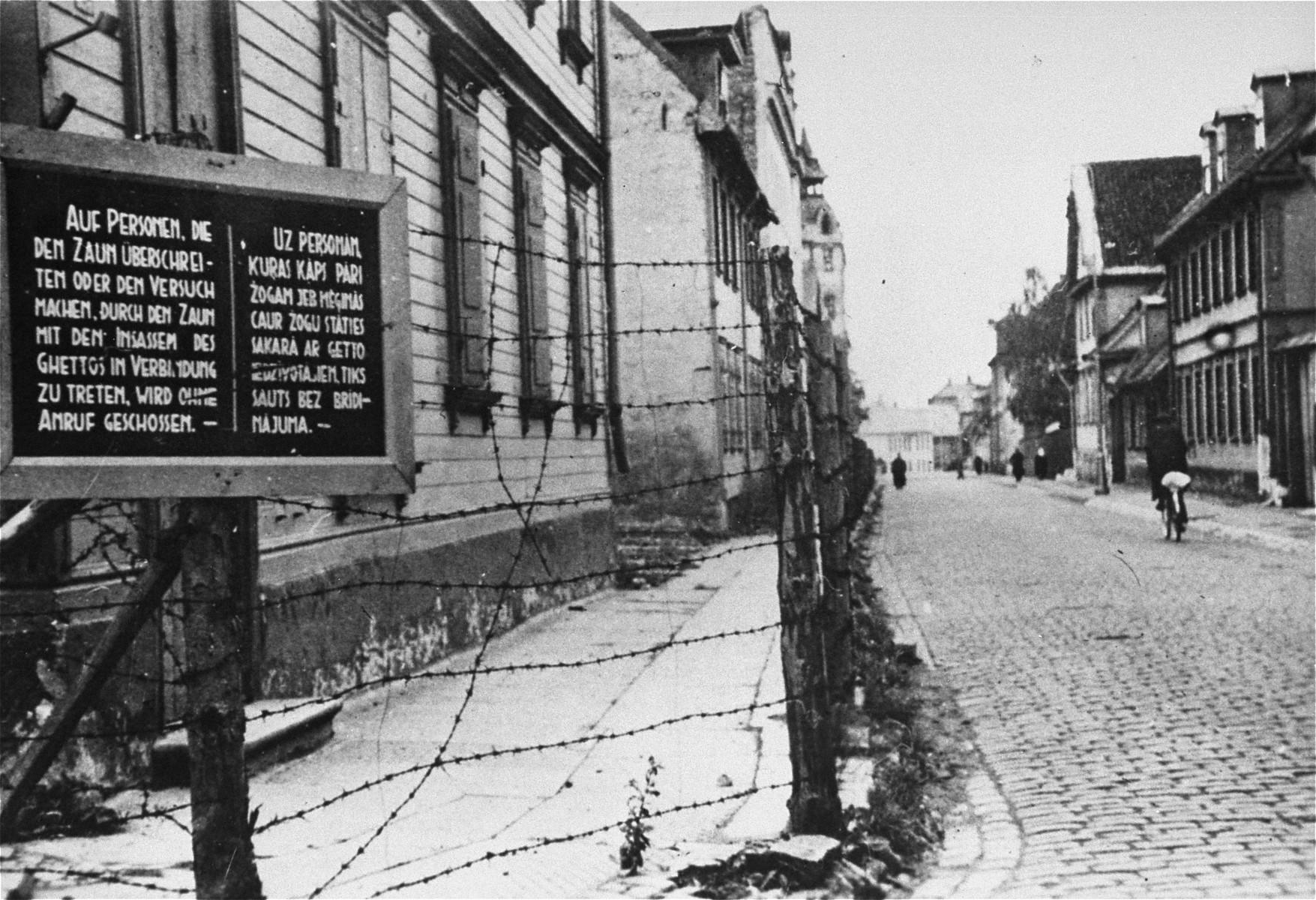
Cover Image: A sign in German and Latvian forbidding unauthorized entrance into the ghetto, Riga, [Vidzeme] Latvia, 1941-1943 / United States Holocaust Memorial Museum, courtesy of Emmi Lowenstern
-