Black Sea Region in War and under Occupation: Diversifying Sources for Teaching and Research


23.4.2026
Elie Wiesel National Institute for the Study of the Holocaust, Bucharest
The workshop focuses on individual experiences of the Second World War and its immediate aftermath on the northern Black Sea coast. The main emphasis will be on visual sources and ego-documents, and on their potential for teaching and research. These still undervalued types of sources can help not only to fill in the gaps in the reconstruction of the course of historical events, but also in exploring agency and subjectivities, mechanisms of social interaction, processes of decision-making, biographical trajectories, histories of emotions, bodily aspects, impacts of climate and weather, everyday life dimensions, and many more. Furthermore, such sources can also bring to light the actors previously understudied in wartime contexts: families, professions and corporations, friendly circles, and informal networks of solidarity. Fragmentary and decontextualized, ego-documents and visual sources are often dispersed and marginalized in the funds of big state archives. On the other hand, in the case of private possession, these sources are threatened by a lack of expertise and attention, loss of meaning in the event of intergenerational splits, and a focus on commercial gain—often leading to the loss of metadata and limited access for researchers. Especially when the ego-documents tell about the wartime and extreme violence, their preservation, and circulation depended on socially constructed (and legally defined) issues of guilt and im/morality, belonging and marginality, honor, disgrace, and patriotism. We aim to explore the potential of lesser-known, censored, marginalized, or undervalued sources and to enhance their use in teaching and research on the Second World War in a special region of the Black Sea.
The Black Sea region is especially relevant in this sense because the research and teaching of the context with multiplicity of languages, cultures, and ethnicities, as well as different experiences of proximity to the frontline and occupation power centers, and multiple temporalities of occupations and genocidal practices, require joint efforts of translation, discussion, and confrontation of diverse sources. Multiple practices of social and political re/bordering, migrations, and deportations taking place during and in the wake of WWII impacted personal narrations, documentations, and witnessing. A combination of ego-documents and visual sources can provide a productive match when, for example, silenced and erased aspects can be "accidentally" present in the source as unintended "background objects" or "blurted out" in the personal narration. Focus on the northern part of the Black Sea region can be productive for further development of relatively young disciplines, such as environmental history or borderlands studies, as well as for creative comparisons and entangled histories beyond the existing political borders and established macro-regional divisions (for example, going beyond "post-Soviet space", "Balkans", or "Eastern and Southern Europe").
This one-day, practically oriented workshop aims to bridge research and educational agendas by inviting scholars to share primary sources from their research archives, while also invigorating methodological discussions centered on the specificity of the chosen sources. We ask participants to prepare a short 15-minute presentation on selected primary source/s. It can be a single source or several. The list of sources from all the participants will be made available beforehand, so that we can prepare for a fruitful discussion.
Particular attention is invited to be paid to the following categories of sources:
- photographs (documenting crimes and post-war justice, perpetrator photography, trophy photography);
- artistic (creative) works;
- visual components in press and propaganda;
- personal official documents (ID cards, ownership documents, wills, personal financial documents, etc);
- ego-documents (diaries, letters, memoirs, essays, etc);
- testimonies (courts' statements and transcripts, oral history interviews, etc).
The workshop is a part of the ongoing programs of the two institutions:
- "REESOURCES: Rethinking Eastern Europe" educational platform of the Center for Urban History, in particular, the project "Digital Resources for Teaching the Black Sea Region" supported by the Center for Governance and Culture in Europe at the University of St. Gallen.
- "Rethinking Areas: Black Sea Region" research area at the Research Centre Ukraine / Max Weber Foundation funded by the German Federal Ministry of Research, Technology and Space (BMFTR).
REESOURCES offers resources designed to decentralize curricula on the history of Eastern Europe by diversifying the sources used in teaching, to spark discussions about established metanarratives, and to foster new approaches to teaching and studying the region. The platform is based on the principles of open access, historical inclusivity (incorporating peripheral and marginalized experiences), and critical engagement with sources. These three concepts form the foundation of the project: creating opportunities to uncover history, explore it, and make educational materials accessible to diverse audiences and communities.
The workshop's working language will be English.
The organizers are covering the participants' travel and accommodation expenses.
Contacts:
- Nadia Skokova, Center for Urban History, n.skokova@lvivcenter.org.ua
- Ivanna Cherchovych, Center for Urban History, i.cherchovych@lvivcenter.org.ua
Co-organizers:
- Center for Urban History (Lviv, Ukraine)
- Elie Wiesel National Institute for the Study of the Holocaust (Bucharest, Romania)
- Research Centre Ukraine / Max Weber Foundation (Lviv, Ukraine)
- Center for Crimean Studies of Kyiv-Mohyla Academy (Kyiv, Ukraine)
- Center for Governance and Culture in Europe of St Gallen University.



Credits
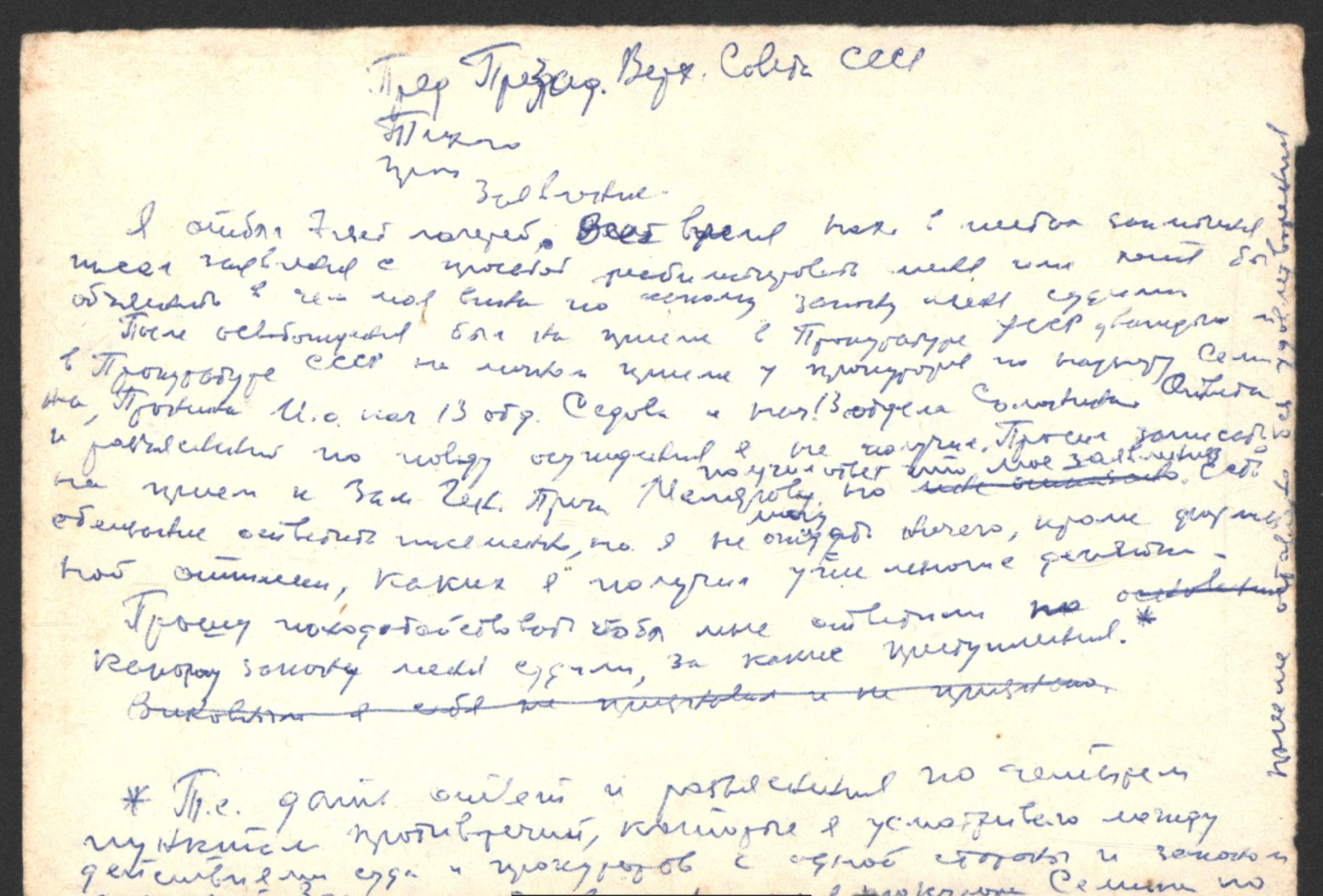
Cover Image: Draft of Oleksa Tykhyi's complaint to the Chairman of the Presidium of the Supreme Soviet of the USSR, January 12, 1973 / collection of Yevhen Fialko / Urban Media Archive of the Center for Urban History