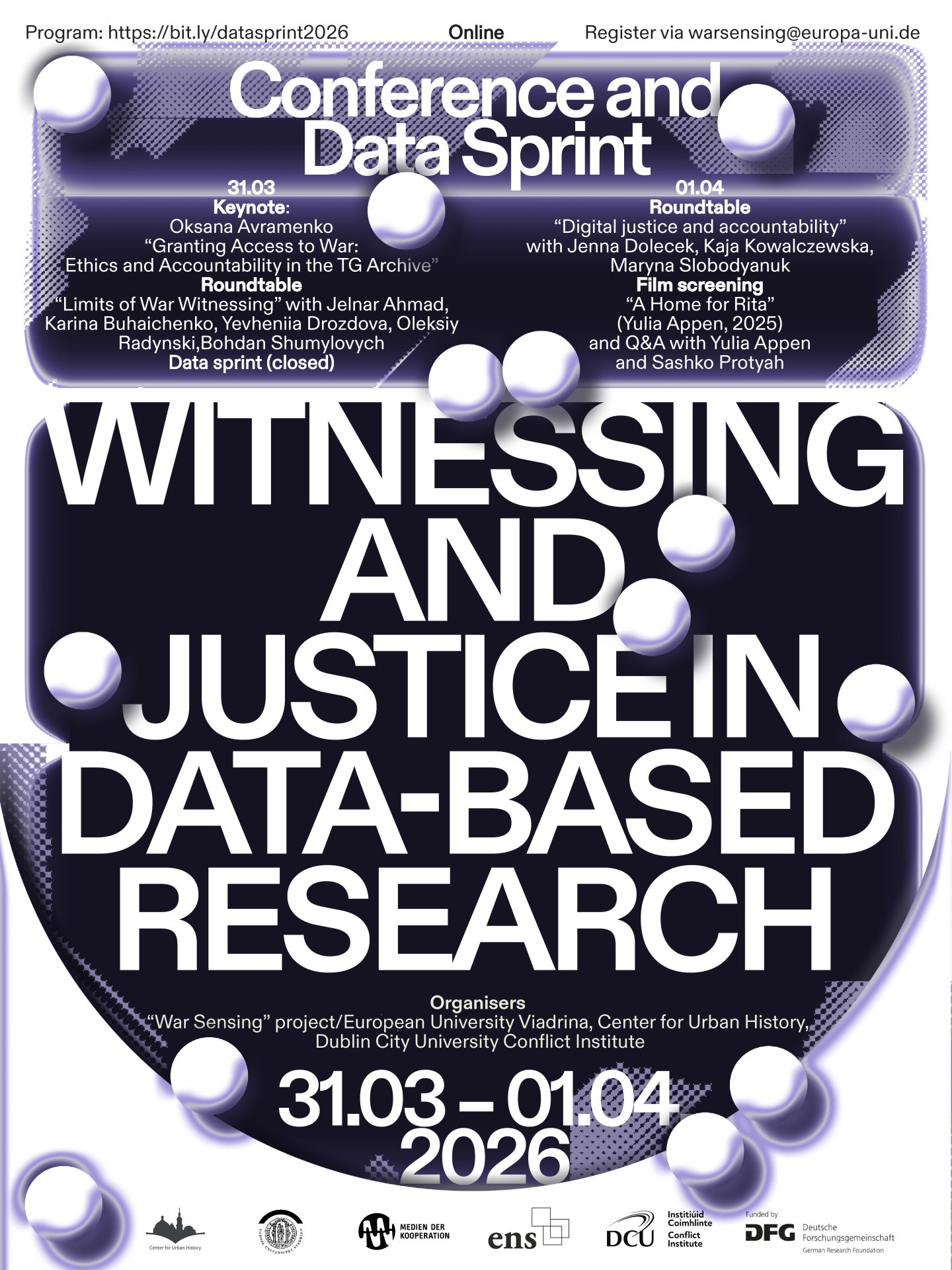
Data Sprint 2026: Witnessing and Justice in Data-Based Research


31.3-1.4.2026
European-University Viadrina / CRC 1187 project "War Sensing" and the Center for Urban History / Telegram Archive of the War
Digital media and data practices shape both war representation and its memory practices. The second data sprint follows on from the hybrid conference and data sprint "War Sensing through the Telegram Archive of the War" (TG Archive) that was organized by the "War Sensing" project (Viadrina University/SFB 1187) and the Center for Urban History in Lviv in 2025. The latter event included keynote speakers, provided tutorials and kicked off project-based hands-on work with the data from the TG Archive with the focus on the topics of filtration and detention, sabotage, everyday witnessing and trustworthiness of OSI(NT) on Telegram.
In the upcoming second data sprint "Digital Witnessing and Justice in Data-Based Research" in 2026, first, we aim to provide a space for the project-based research work update that continues after the 2025 data sprint. What results did the bottom-up research collaborations formed during the first data sprint produce, how did they continue their work, and what are the future research plans? During the data sprint, the archivists from the TG Archive and beyond will consult and reflect upon the use of the archive's data – both for the research projects directly and for research as such using the TG Archive.
Furthermore, with the help of data sprint participants and invited speakers, we will reflect upon the limits of research based on digital and archived data. The urgent question here is how to address the ongoing tension between such data-based research of war and the injustices that persist. Despite the large volume of data and diverse representations of the war in Ukraine produced to document and analyze its unjust nature and practices, the destruction and attacks against Ukraine continue.
Data-based investigations using "data for the good" (cf. Williams, 2022; DATACTIVE) form a small part of achieving transitional justice and maintain hope and accountability by using digitally derived evidence of war injustices and crimes. (How) do digital data archives and data-based investigations continue to counter injustices, and what approaches have proved as successful in countering war-related injustices? What are the various limitations of digital data-based witnessing of war in terms of experiential, juridical, political and other natures? How can the tension between the investigations and ongoing injustices tell us about the role and impact of modern war witnessing?
Public Program
DAY 1, 31.03.2026
- Keynote lecture, 09:00-10:00 Dublin / 10:00-11:00 Frankfurt (Oder) / 11.00-12.00 Lviv | online
Granting Access to War: Ethics and Accountability in the TG Archive by Oksana Avramenko (Center for Urban History, Lviv), moderated by Dr. Tanya Lokot.
- Roundtable, 10:30-12:00 Dublin / 11:30-13:30 Frankfurt (Oder) / 12.30-14.00 Lviv | online
Limits of War Witnessing with contributions by Bohdan Schumylovych (Center for Urban History) & Oleksiy Radynski (Reckoning Project), Yevheniia Drozdova (Texty.org.ua), Jelnar Ahmad (Syrian Archive, tbd), moderated by Prof. Dr. Miglė Bareikytė
DAY 2, 1.4.2026
- Roundtable 15.30–17.00 Dublin / 16.30–18.00 Frankfurt (Oder) / 17.30–19.00 Lviv | online
Digital Justice and Accountability: War Crime Documentation—Courts: Success Stories and Challenges of Using Digital Data for Countering Injustices with contributions by Maryna Slobodyanuk (Truthhounds), Jenna Dolecek (OSINT for Ukraine), Kaja Kowalczewska (Incubator of Science Excellence—Digital Justice, University of Wrocław), moderated by Johanna Hiebl
- Film Screening and Q&A 17.00-18.30 Dublin/18.00-19.30 Frankfurt (Oder)/19.00-20.30 Lviv | online
Limits of War Witnessing: What is being less documented? with Sashko Protyakh & Yuliia Apen (Freefilmers)