Overlooked: Revisiting the Histories of Ghettos in Occupied Territories of Contemporary Ukraine, Poland, Lithuania, and Moldova


13-14.10.2025
Center for Urban History, Lviv
The history of ghettos is at the core of the ways the Holocaust and, more generally, the Second World War is studied and represented. Together with the history of camps, the history of ghettos constitutes historiographical and conceptual cornerstones of Holocaust history. The "Encyclopedia of Camps and Ghettos, 1933–1945" lists over 40,000 sites of persecution, forced labor, imprisonment, and murder, and over 1150 ghettos in Nazi-occupied and Nazi-allied Europe and North Africa. The experiences of ghettos are crucial for understanding the experiences of the Holocaust on the ground. Exploring different trajectories of ghettos' establishment, functioning and destruction "from below" allows for tracing diverse dynamics in Nazi anti-Jewish murderous policies, entangled relations with non-Jewish residents and neighbors, including the involvement of the latter in mass murder of Jews, as well as lasting legacies of the Holocaust on Jewish communities and individual lives as well as on the places of their life and killings. Most of what we know about ghettos during World War II, as well as how the public imagines them, comes from research and cultural portrayals of the larger ghettos. The archetypal image of the ghetto is shaped by Warsaw, the largest and most extensively documented ghetto. There is a long list of academic works, digital projects, and films, to name just major formats. Over the last two decades, we have gained a deeper understanding of ghettos in major cities of Central Europe, such as Budapest (Cole, 2003) and Theresienstadt (Hajkova, 2020). Smaller towns rarely get to be the focus of a scholarly monograph. Yet, this perspective is promising, and new publications start to appear, for example, about the ghetto in Zdolbuniv (Dolhanov, 2024). Some more are in the process of research and writing.
This shape of historiographic knowledge partly inspired the title of the seminar, which begins with the word "overlooked." When we hear "overlooked," we might first think of smaller ghettos, typically located in towns or semi-rural areas. Yet, being overlooked does not necessarily depend on size. Historiographies can produce blind spots because dominant structures and perspectives define what is considered central, what is peripheral or marginal, and what goes entirely unaccounted for. The case of Lviv/Lwów/לעמבעריק/Lemberg illustrates how certain experiences and spaces are neglected in the historical record, not because they were historically insignificant, but because they fell out of historiographical boundaries. These boundaries were defined by postwar political borders, as well as centers and peripheries of attention within nationally shaped historical narratives. In other words, the narratives of the Holocaust in Poland focused more on the cities within post-1945 borders (like Warsaw or Łódź), while the narratives of the Holocaust in Ukraine focus on the Babi Yar in Kyiv, which represents thousands of ravines and a story of the Holocaust by bullets (Berkhoff, 2004; Desbois, 2008). This raises the critical question: why and how some locations remain overlooked, and how might we expand our gaze to include perspectives and sites that have traditionally been marginalized? By interrogating these gaps, we aim to challenge and broaden the frameworks through which the history of ghettos is conceptualized and understood.
Our aim, therefore, is not merely to extend the list of studied ghettos but to explore the possibilities of revisiting the very notion of the ghetto by focusing on some of the ghettos that have been overlooked. We hope that this workshop will launch a series of events and cooperation formats that will bring scholars to reflect on the ghetto as a concept and a notion, as a historical phenomenon and societal practice, as well as the ways it has been historiographically constructed. One way to do this would be to revisit some of the temporal and spatial dimensions by focusing on everyday interactions, networks, and practices, as well as experiences, expertise, emotions, and sensory realities. Reflecting on available and possible sources would be another. The richness of the scholarship on the Warsaw Ghetto reflects the extraordinary collection of sources, namely the Oneg Shabbat underground archive. In most other cases, what remains and is available are documents from the occupying authorities, memoirs, and even artworks, which necessitate a different approach and also frame the questions we can ask. Thus, one avenue of research would be to explore potential new sources as well as the potential of existing ones. In examining what has been overlooked, we aim to reflect on the conceptual frameworks in contemporary scholarship, to sketch new perspectives on how ghettos can be studied and understood, to ask what broader contexts might be considered and how developing a more nuanced, inclusive, and multidimensional history of ghettos can contribute to a better understanding of the experiences of war and occupation, and their legacies in the region and beyond.
Program Committee:
- Sofia Dyak, Center for Urban History
- Iryna Klymenko, Research Centre Ukraine / Max Weber Foundation
- Vladyslava Moskalets, Center for Urban History / Ukrainian Catholic University
- Nadia Skokova, Center for Urban History
Organizational Committee:
- Sofia Andrusyshyn, Center for Urban History
- Maryana Mazurak, Center for Urban History
- Natalia Machalina, Research Centre Ukraine / Max Weber Foundation
The workshop is co-organized by the Center for Urban History and Research Centre Ukraine / Max Weber Foundation in partnership with Warsaw Ghetto Museum.


Credits
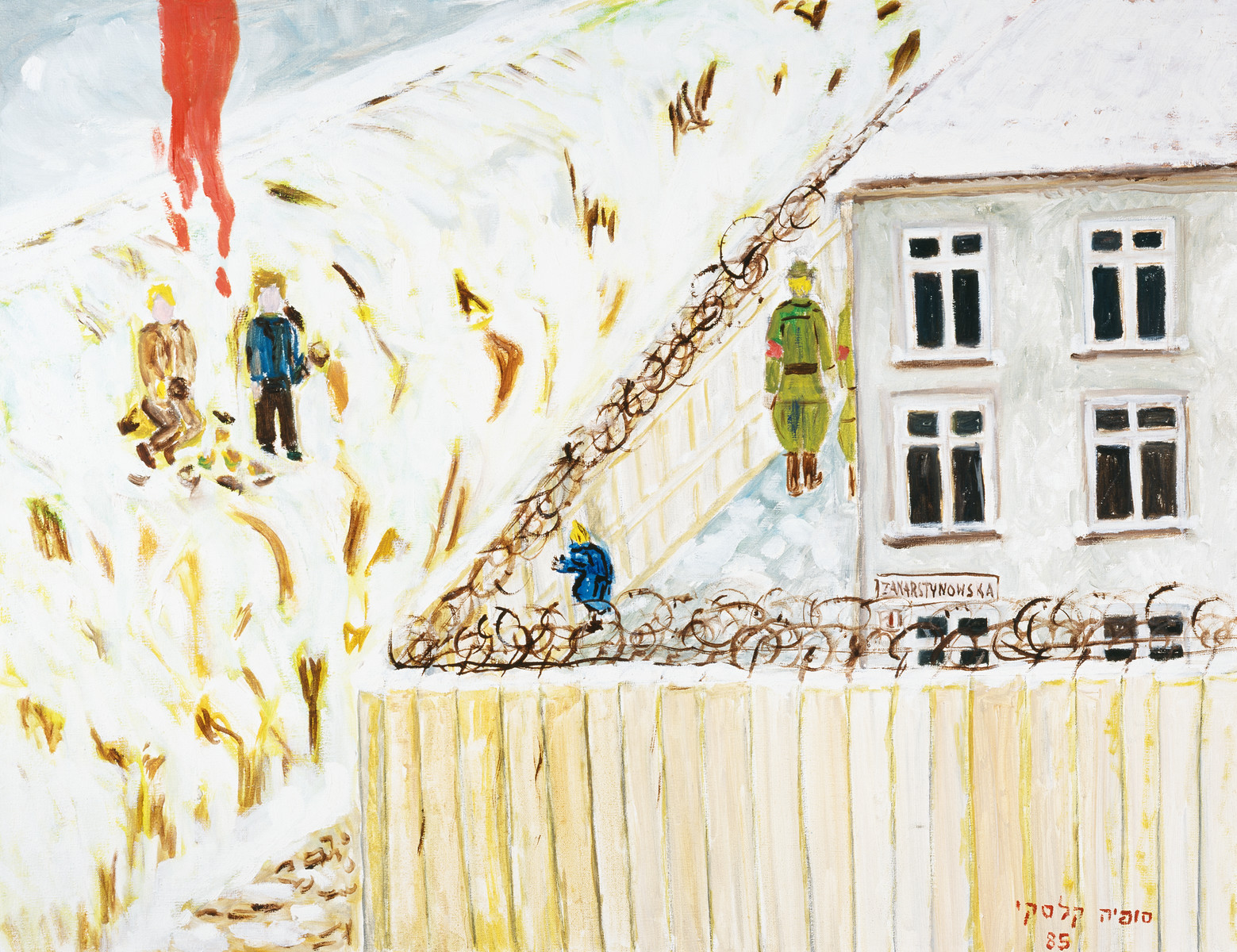
Cover Image: A painting by artist Sophia Kalski entitled "Escape from Lwow ghetto, end of March 1943. Zamarstynowska #1." / United States Holocaust Memorial Museum